

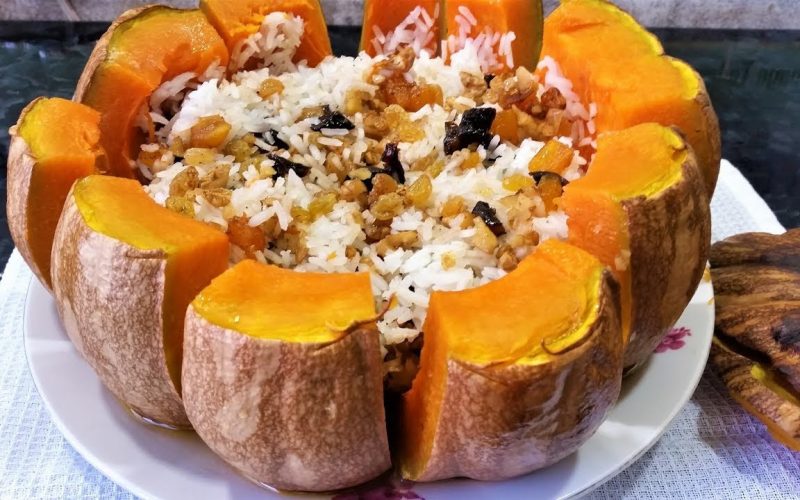
Hapama is one of the most iconic and beloved dishes in Armenian cuisine. At its core, Hapama is a whole pumpkin carefully hollowed out and filled with a rich, aromatic mixture of rice, dried fruits, nuts, honey, butter, and fragrant spices. The stuffed pumpkin is then baked slowly in the oven until the flesh becomes tender and infused with the sweet and savory flavors of its filling.
The preparation begins with selecting a medium-sized pumpkin, usually round and symmetrical, which serves as both the cooking vessel and the edible centerpiece. Inside, a mixture of partially cooked rice is combined with ingredients such as raisins, dried apricots, prunes, almonds, walnuts, and sometimes dates. Honey adds natural sweetness, while cinnamon and other spices contribute warmth and complexity. Butter enriches the texture, creating a luxurious, comforting dish.
Visually, Hapama is striking. When presented at the table, the golden-orange pumpkin appears whole and intact, often with its lid replaced after baking. Once cut open, the interior reveals a colorful mosaic of rice, jewel-like dried fruits, and nuts. The contrast between the bright orange pumpkin flesh and the rich filling creates a stunning presentation that immediately signals celebration.
The aroma of Hapama is equally captivating. As it bakes, the scent of roasted pumpkin blends with honey, cinnamon, and dried fruits, filling the kitchen with a warm, festive fragrance. This aroma alone is enough to evoke memories of family gatherings and holidays for many Armenians.
In terms of taste, Hapama offers a harmonious balance of sweetness and earthiness. The pumpkin flesh becomes soft and slightly caramelized, complementing the tender rice and sweet fruits. The nuts add crunch and depth, while honey and spices create a comforting, layered flavor profile. The result is a dish that is both nourishing and indulgent, simple in its ingredients yet sophisticated in its composition.
Hapama is not merely a recipe—it is a symbol. Its abundance of ingredients represents prosperity, fertility, and the richness of life. Because of its visual beauty, festive aroma, and symbolic meaning, Hapama has long been considered both a culinary treasure and a cultural emblem of Armenia.
Why Hapama Is More Than Just Food
In Armenia, Hapama is far more than a delicious pumpkin dish. It is deeply connected to Armenian identity, heritage, and cultural continuity. For generations, Armenian families have prepared Hapama during important celebrations, ensuring that culinary traditions are passed down from parents to children.
Food plays a central role in Armenian culture, and Hapama occupies a special place among traditional dishes because of its symbolic associations. The pumpkin itself represents wholeness and protection, while the grains of rice symbolize abundance and sustenance. The dried fruits and nuts, harvested and preserved from previous seasons, represent continuity, memory, and the connection between past and present.
Hapama is especially associated with family unity. It is often prepared for large gatherings, weddings, religious holidays, and harvest celebrations. When the pumpkin is brought to the table, it becomes a shared experience. Cutting the pumpkin and serving its filling is a communal act, reinforcing bonds between family members and guests.
In Armenian tradition, food is not only nourishment for the body but also nourishment for the soul. Preparing Hapama involves care, patience, and intention. Many families follow rituals while cooking, using recipes inherited from grandparents and adding their own personal touches. These small variations reflect regional differences and individual family histories.
Emotionally, Hapama carries powerful meaning. For Armenians living in the diaspora, preparing Hapama can be an act of cultural preservation and identity. It serves as a reminder of homeland, ancestry, and belonging. The smell of baked pumpkin and honey can evoke memories of childhood, grandparents’ kitchens, and festive occasions.
In this way, Hapama functions as a cultural bridge—connecting generations, preserving traditions, and reinforcing Armenian identity. It demonstrates how food can carry stories, values, and emotions far beyond its physical ingredients.
Overview of the Article
This article explores Hapama not only as a traditional Armenian dish but also as a cultural and symbolic phenomenon. Readers will gain a comprehensive understanding of Hapama’s origins, meaning, preparation, and ongoing relevance in modern Armenian life.
First, the article will examine the historical roots of Hapama, exploring how the dish developed over centuries and how it reflects Armenia’s agricultural traditions and environment. It will also discuss how the ingredients of Hapama reflect seasonal cycles and local resources.
Next, the article will explore the symbolism of Hapama in Armenian culture, including its role in celebrations, rituals, and family traditions. Readers will learn why this dish is associated with prosperity, unity, and continuity.
The article will also provide insight into the traditional preparation of Hapama, including the ingredients, techniques, and cultural practices involved in making it. This includes how families select pumpkins, prepare fillings, and present the finished dish.
In addition, readers will discover how Hapama has evolved over time. While the traditional recipe remains widely respected, modern adaptations have introduced new ingredients and creative variations. These adaptations demonstrate how cultural traditions can evolve while still preserving their core meaning.
Finally, the article will emphasize the importance of preserving traditional recipes like Hapama. In a rapidly globalizing world, culinary traditions play a crucial role in maintaining cultural identity and historical continuity. By continuing to prepare and share dishes like Hapama, Armenian families ensure that their heritage remains alive for future generations.
Hapama is more than a recipe—it is a story, a symbol, and a living tradition. Through understanding Hapama, we gain insight into Armenian culture, values, and the enduring power of food to connect people across time and place.
Historical Origins of Hapama
Armenian cuisine is widely considered one of the oldest continuous culinary traditions in the world, shaped by thousands of years of settlement, agriculture, and cultural exchange in the Armenian Highlands. This mountainous region, located at the crossroads of Eastern Europe and Western Asia, has historically served as a bridge between civilizations, including Persia, Mesopotamia, Anatolia, and the Caucasus. As a result, Armenian food traditions reflect both deep local roots and influences from neighboring cultures.
The geography of Armenia played a decisive role in shaping its cuisine. The Armenian Highlands are characterized by fertile valleys, high-altitude plains, and diverse microclimates. These conditions allowed ancient Armenians to cultivate a wide variety of crops despite challenging terrain. Archaeological evidence shows that agriculture in the region dates back more than 6,000 years, with early communities growing grains such as wheat and barley, as well as legumes, fruits, and nuts.
Grains formed the foundation of the Armenian diet. Wheat, in particular, was central not only as a food source but also as a cultural symbol of life and prosperity. Rice, although introduced later through trade routes connecting Armenia with Asia, eventually became an important ingredient in many traditional dishes, including Hapama.
Fruits and nuts were equally essential. Armenia’s climate supported orchards of apricots, grapes, apples, pomegranates, and plums. In fact, the apricot is so strongly associated with Armenia that its scientific name, Prunus armeniaca, literally means “Armenian plum.” These fruits were consumed fresh during harvest and preserved through drying for use during winter months. Dried fruits such as apricots, raisins, and prunes became staples in many Armenian recipes, including festive dishes.
Nuts such as walnuts and almonds were also abundant. They provided valuable nutrition and added texture and flavor to foods. Walnuts, in particular, became a defining ingredient in Armenian cuisine and are still widely used today.
Pumpkins and other squash varieties were well suited to Armenia’s agricultural conditions. They could be grown relatively easily, stored for long periods, and used in a wide range of dishes. Their natural sweetness and durable outer shell made them ideal candidates for baking and stuffing.
These agricultural staples—grains, fruits, nuts, and pumpkins—formed the foundation upon which Hapama would eventually emerge. The dish reflects the abundance of the Armenian land and the agricultural knowledge developed over centuries.
The Origin of Stuffed Vegetable Dishes in Armenia
The practice of stuffing vegetables has deep roots in Armenian culinary tradition. Known broadly by the term dolma, stuffed dishes have been prepared in Armenia for centuries and remain among the most beloved foods in Armenian households.
Common stuffed vegetables include grape leaves, cabbage leaves, eggplants, peppers, tomatoes, and zucchini. These vegetables are typically filled with mixtures of grains, herbs, meats, or legumes, depending on the season and occasion. The technique of stuffing vegetables allowed cooks to create nourishing, flavorful meals using available ingredients.
There were both practical and cultural reasons for this culinary technique.
From a practical standpoint, stuffing vegetables was an efficient way to use limited resources. By combining grains, vegetables, and small amounts of meat or dried fruits, families could create satisfying meals that stretched available food supplies. This was especially important in mountainous regions where agricultural production could be unpredictable.
Stuffing also helped preserve food and enhance flavor. Cooking grains and fillings inside vegetables allowed flavors to blend and develop slowly. The vegetable itself served as a natural cooking container, protecting the filling and preventing moisture loss.
From a cultural perspective, stuffed dishes carried symbolic meaning. The act of filling something whole represented abundance and generosity. Serving stuffed dishes to guests was a sign of hospitality and care.
Over time, stuffed dishes evolved from everyday meals into ceremonial foods. Special occasions called for more elaborate fillings, richer ingredients, and more decorative presentations. Instead of simple vegetable wrappers, larger and more visually impressive vegetables—such as pumpkins—were used for festive preparations.
This evolution laid the foundation for the creation of Hapama.
Emergence of Hapama as a Festive Dish
While it is difficult to identify the exact moment when Hapama first appeared, culinary historians believe it likely developed as a festive dish associated with harvest celebrations. The key ingredients—pumpkin, grains, dried fruits, nuts, and honey—are all closely tied to the agricultural cycle and autumn harvest.
Harvest season was one of the most important periods in Armenian rural life. It marked the successful gathering of crops that would sustain families through the winter. Communities celebrated the harvest with feasts that showcased the abundance of the land. Dishes prepared during this time often featured freshly harvested produce combined with preserved foods from previous seasons.
Pumpkins, harvested in autumn, were especially suitable for festive cooking. Their large size made them ideal for feeding groups of people, and their bright color symbolized warmth, life, and abundance.
The pumpkin’s physical structure made it uniquely suited as a cooking vessel. Its thick outer shell could withstand long baking times without collapsing, while its interior flesh softened and absorbed the flavors of the filling. Unlike smaller vegetables, a whole pumpkin could serve as both a cooking container and a dramatic centerpiece.
The visual impact of presenting a whole stuffed pumpkin also contributed to its ceremonial role. Bringing a fully intact, golden pumpkin to the table created a sense of anticipation and celebration. Cutting it open revealed the rich filling inside, reinforcing themes of abundance and generosity.
Because of these qualities, the pumpkin became the preferred vessel for this special dish. Over time, Hapama became strongly associated with festive occasions, particularly autumn celebrations and important family gatherings.
Hapama in Medieval and Early Modern Armenia
Although written culinary records from medieval Armenia are limited, evidence of Hapama’s existence survives through folklore, oral tradition, and cultural memory. Armenian folk songs, proverbs, and storytelling traditions often mention festive meals featuring stuffed foods and harvest ingredients.
Hapama, in particular, is remembered not only as a dish but as part of ritual celebrations. In some traditions, the preparation and serving of Hapama were accompanied by songs and ceremonial gestures. These practices reinforced the dish’s symbolic role as a representation of abundance and unity.
Over time, the exact ingredients used in Hapama varied depending on regional availability and economic conditions. In wealthier households, the filling might include larger quantities of nuts, butter, and honey. In more modest homes, families used whatever ingredients were available, such as locally dried fruits or smaller amounts of sweeteners.
Regional differences also influenced preparation methods. In some areas, additional spices such as cloves or cardamom were used, reflecting trade connections with neighboring regions. In others, simpler versions emphasized the natural sweetness of pumpkin and dried fruits.
Despite these variations, the core concept of Hapama remained consistent: a whole pumpkin filled with grains and preserved harvest ingredients, baked and shared during meaningful occasions.
The survival of Hapama through centuries of political change, migration, and hardship reflects the resilience of Armenian culture. Even when written records were scarce, families preserved the recipe through oral transmission, teaching each generation how to prepare the dish.
This continuity demonstrates that Hapama is not merely a culinary invention but a living tradition—one that connects modern Armenians with their ancient ancestors and preserves the memory of Armenia’s agricultural and cultural heritage.
Cultural and Symbolic Meaning of Hapama
At the heart of Hapama lies the pumpkin itself, which carries deep symbolic meaning in Armenian culture. Beyond its culinary function, the pumpkin represents abundance, fertility, protection, and the life-giving power of the earth.
The pumpkin’s large size and ability to contain a generous filling make it a natural symbol of abundance. In agricultural societies like traditional Armenia, a plentiful harvest meant survival, stability, and prosperity. The pumpkin, with its thick flesh and capacity to nourish many people, became a visual and edible representation of nature’s generosity.
The pumpkin is also closely connected to fertility. Its many seeds symbolize the potential for new life and growth. In traditional symbolism, seeds represent continuity across generations, reinforcing the idea that life is ongoing and ever-renewing. When used in Hapama, the pumpkin becomes a metaphor for the family itself—a protective vessel that nurtures and sustains life.
Its association with the harvest season further strengthens its symbolic value. Pumpkins are harvested in autumn, a time when farmers gather the results of their labor and prepare for the winter ahead. This seasonal timing connects Hapama directly to themes of gratitude, completion, and renewal.
In addition, the pumpkin’s hard outer shell represents protection. It safeguards the nourishing filling inside, much like a home protects its family members. This symbolism aligns with Armenian cultural values that emphasize the importance of family, security, and mutual care.
Thus, the pumpkin in Hapama is not merely an ingredient—it is a powerful cultural symbol representing life, abundance, protection, and the enduring relationship between people and the land.
Symbolism of the Filling Ingredients
The filling of Hapama is composed of ingredients that are individually rich in symbolic meaning. Each component contributes not only to the dish’s flavor but also to its cultural and emotional significance.
Rice: Symbol of Life, Growth, and Continuity
Rice is one of the most important symbolic ingredients in Hapama. As a grain, it represents life, nourishment, and continuity. Grains have long been associated with survival because they can be stored, planted, and harvested repeatedly.
In Armenian symbolism, rice represents growth and the continuation of family lines. Each grain can be seen as a metaphor for an individual life, and together, the grains form a unified whole. This reflects the structure of family and community—many individuals connected into one shared identity.
Rice also represents stability and sustenance. Including rice in Hapama emphasizes the hope for security, nourishment, and continuity in the coming year.
Dried Fruits: Symbol of Sweetness and Happiness
Dried fruits such as apricots, raisins, and prunes add natural sweetness and vibrant color to Hapama. Symbolically, they represent the sweetness of life and the hope for happiness.
Because dried fruits are preserved from previous harvests, they also symbolize memory and continuity. They connect the present moment with the past, reminding families of previous seasons and generations.
Their sweetness expresses a wish for joy, emotional warmth, and positive experiences. Including dried fruits in Hapama represents the desire for a life filled with pleasant moments and meaningful relationships.
Nuts: Symbol of Strength, Longevity, and Resilience
Nuts, especially walnuts and almonds, are essential ingredients in Hapama and carry important symbolic meaning. Their hard shells represent protection and endurance, while the nourishing interior symbolizes inner strength.
In Armenian tradition, nuts represent resilience and longevity. Trees that produce nuts live for many years, continuing to bear fruit across generations. This makes them a symbol of stability and long life.
Including nuts in Hapama expresses hope for strength, health, and the ability to withstand life’s challenges.
Honey: Symbol of Prosperity, Blessing, and Sweetness
Honey has long been associated with prosperity and divine blessing in Armenian and many other cultures. Its natural sweetness represents the hope for a prosperous and joyful life.
Because honey is produced through careful, collective effort by bees, it also symbolizes cooperation and harmony. This reinforces the theme of unity and shared effort within families and communities.
In Hapama, honey binds the ingredients together, both physically and symbolically. It represents the sweetness that comes from unity, love, and shared experiences.
Hapama as a Symbol of Unity
One of the most profound meanings of Hapama lies in its representation of unity. The dish itself is physically whole—a single pumpkin containing many individual ingredients. This structure reflects the Armenian concept of family as a unified entity composed of many members.
The whole pumpkin represents the family unit. Each grain of rice, piece of fruit, and nut represents an individual. Alone, each ingredient is meaningful, but together they create something richer and more complete. This reflects the Armenian belief that family strength comes from togetherness.
The act of sharing Hapama reinforces this symbolism. When the pumpkin is brought to the table and opened, it becomes a shared experience. Family members gather around, and portions are distributed among everyone present. This act of sharing strengthens emotional bonds and reinforces the importance of unity.
Preparing Hapama itself is often a communal activity. Multiple family members may participate in cleaning the pumpkin, preparing the filling, and assembling the dish. This collaborative process strengthens relationships and creates shared memories.
In this way, Hapama symbolizes not only abundance but also connection, cooperation, and belonging.
Hapama in Armenian Folklore and Songs
Hapama occupies a special place in Armenian folklore, music, and oral tradition. One of the most well-known Armenian folk songs is dedicated entirely to Hapama. This song, often performed during celebrations, describes the preparation and presentation of the dish.
The song typically portrays Hapama as a festive centerpiece, bringing joy and unity to the family. It emphasizes the emotional warmth associated with sharing the dish and the happiness it brings to gatherings.
Through songs and storytelling, Hapama has become more than a recipe—it has become part of Armenia’s cultural memory. These artistic expressions help preserve traditions and pass them down to future generations.
Folklore often uses food as a symbol of home, comfort, and identity. Hapama, with its visual beauty and symbolic richness, naturally became a subject of cultural storytelling.
Even today, references to Hapama evoke feelings of nostalgia, belonging, and cultural pride among Armenians around the world.
Hapama in Armenian Holidays and Celebrations
New Year Celebrations (Amanor)
Amanor, the Armenian New Year, is one of the most important celebrations in Armenian culture. During this holiday, families prepare symbolic foods that represent hopes for the coming year.
Hapama is often included in New Year celebrations because of its strong association with abundance and prosperity. The abundance of ingredients inside the pumpkin symbolizes a wish for a year filled with nourishment, success, and happiness.
Serving Hapama at New Year reflects the desire to begin the year with unity and gratitude. The act of sharing the dish reinforces family bonds and expresses hope for continued prosperity.
Christmas Celebrations
Hapama is also prepared during Armenian Christmas celebrations, which are observed on January 6 in the Armenian Apostolic tradition. Christmas is a time of spiritual reflection, gratitude, and family gathering.
The symbolic ingredients of Hapama align with the themes of blessing, renewal, and unity associated with Christmas. The sweetness of honey and fruits represents joy and divine grace, while the abundance of the filling reflects gratitude for life’s blessings.
Serving Hapama during Christmas reinforces the connection between food, faith, and family tradition.
Harvest Festivals
Hapama has deep roots in harvest celebrations, reflecting its agricultural origins. Harvest festivals mark the completion of the growing season and express gratitude for nature’s abundance.
Preparing Hapama during harvest season honors the earth and the labor required to produce food. The dish incorporates ingredients harvested throughout the year, symbolizing the successful completion of the agricultural cycle.
The pumpkin itself, harvested in autumn, serves as a direct representation of the harvest.
Weddings and Family Celebrations
Hapama is frequently served at weddings and other major family events. In this context, it symbolizes fertility, prosperity, and happiness for the newly formed family.
The pumpkin’s seeds represent fertility and the hope for future generations. The sweetness of the filling symbolizes the wish for a joyful and harmonious marriage.
Serving Hapama at weddings expresses blessings for abundance, stability, and family continuity.
Other Cultural and Family Occasions
Hapama is also prepared for many other family and cultural events, including:
- Birthdays
- Family reunions
- Cultural festivals
- Community gatherings
At these events, Hapama serves as both a delicious dish and a symbol of unity. Its presence transforms meals into meaningful rituals, reinforcing cultural identity and shared heritage.
Regardless of the specific occasion, Hapama continues to represent the enduring values of Armenian culture: family, abundance, continuity, and connection.
Regional Variations of Hapama
Although Hapama follows a recognizable core concept—a whole pumpkin filled with rice, dried fruits, nuts, honey, and spices—its exact preparation varies across different regions of Armenia. These variations reflect local agricultural conditions, regional tastes, and family traditions passed down through generations.
Differences in Ingredients
One of the most noticeable regional differences lies in the selection of filling ingredients. Armenia’s diverse microclimates produce different fruits and nuts, which naturally influence local versions of Hapama.
In some regions, dried apricots play a dominant role, reflecting Armenia’s long-standing apricot cultivation. In others, raisins or prunes may be more prominent. Mountainous areas with abundant walnut trees often use generous quantities of walnuts, while regions with access to almonds may incorporate them more heavily.
Some regional recipes include:
- Dried apples or pears for additional sweetness and texture
- Dates, especially in areas influenced by trade routes
- Local wild nuts or seeds
- Grape molasses instead of honey in certain traditional households
Spices also vary. While cinnamon is the most common, some regions include cloves, cardamom, or even a small amount of black pepper to create a more complex flavor profile.
Differences in Preparation Techniques
Preparation techniques also differ depending on tradition and available cooking methods.
In rural areas, Hapama was historically baked in tonir ovens—traditional underground clay ovens used throughout Armenia. Cooking in a tonir gives the pumpkin a distinct smoky aroma and slow, even heat distribution.
In other regions, families may partially cook the rice beforehand, while others place uncooked rice inside the pumpkin, allowing it to absorb moisture and flavor during baking.
Some families brush the inside of the pumpkin with butter or honey before adding the filling to enhance caramelization and flavor. Others mix butter directly into the rice filling.
Presentation can also vary. In certain regions, decorative carvings are made on the pumpkin exterior, while in others the pumpkin is left intact to emphasize its natural beauty.
These regional differences demonstrate the flexibility of Hapama and its ability to adapt while preserving its symbolic essence.
Variations in the Armenian Diaspora
As Armenians migrated to different parts of the world, they brought Hapama with them. Today, Armenian communities in countries such as Russia, Lebanon, France, the United States, and others continue to prepare Hapama, often adapting the recipe to local conditions.
Diaspora communities sometimes modify ingredients based on availability. For example:
- Cranberries or dried cherries may be used instead of traditional dried apricots
- Pecans or hazelnuts may replace walnuts
- Maple syrup may substitute for honey in some regions
- Locally available pumpkin varieties influence texture and flavor
These adaptations allow families to maintain the tradition even when original ingredients are not available.
Climate and ingredient availability also influence pumpkin selection. In some countries, smaller or sweeter pumpkin varieties are preferred, while in others, larger squash varieties may be used.
Despite these changes, the symbolic meaning of Hapama remains intact. Preparing Hapama in diaspora communities often carries even deeper emotional significance, serving as a connection to Armenian heritage and identity.
For many Armenian families living abroad, Hapama represents continuity, memory, and belonging.
Modern Interpretations
In recent decades, contemporary chefs have reinterpreted Hapama while preserving its traditional essence. These modern versions reflect the evolution of Armenian cuisine in the context of global culinary trends.
Some chefs experiment with new ingredients, such as:
- Quinoa or bulgur instead of rice
- Exotic dried fruits like figs, cranberries, or mango
- Pistachios, pine nuts, or other specialty nuts
- Citrus zest for additional aroma
Others focus on presentation. Instead of serving the pumpkin whole, chefs may slice it into portions or present it in individual servings using small pumpkins. This makes the dish more suitable for restaurant settings.
Restaurants may also emphasize visual aesthetics, carefully arranging the filling to highlight color contrast and texture.
Some modern interpretations balance the sweetness with savory elements, incorporating herbs or lightly salted nuts to create a more complex flavor profile.
Despite these innovations, the core identity of Hapama remains unchanged. Even modern versions preserve the central idea of a filled pumpkin representing abundance and unity.
These contemporary interpretations help ensure that Hapama remains relevant while honoring its cultural roots.
Nutritional Value and Health Benefits
Pumpkin, the central ingredient in Hapama, is highly nutritious and offers numerous health benefits.
It is rich in essential vitamins, particularly vitamin A, which supports eye health, immune function, and skin health. Pumpkin also contains vitamin C, which helps strengthen the immune system and supports tissue repair.
Pumpkin is an excellent source of dietary fiber, which promotes healthy digestion and helps regulate blood sugar levels. Fiber also contributes to feelings of fullness, supporting healthy weight management.
In addition, pumpkin contains antioxidants such as beta-carotene. These compounds help protect cells from oxidative stress and support overall health.
Pumpkin is naturally low in calories and fat, making it a healthy base for many dishes.
Benefits of Dried Fruits and Nuts
The dried fruits and nuts used in Hapama provide valuable nutrients and energy.
Dried fruits such as apricots, raisins, and prunes contain:
- Natural sugars for energy
- Dietary fiber for digestive health
- Vitamins such as vitamin A and vitamin K
- Minerals such as potassium and iron
Nuts such as walnuts and almonds provide:
- Healthy fats that support heart health
- Protein, which supports muscle maintenance
- Vitamin E, an important antioxidant
- Magnesium and other essential minerals
These ingredients contribute to the overall nutritional density of Hapama.
Overall Nutritional Balance of Hapama
Hapama offers a balanced combination of carbohydrates, healthy fats, fiber, and essential nutrients.
The rice provides carbohydrates, which serve as the body’s primary energy source. The nuts contribute healthy fats and protein, while the pumpkin and dried fruits provide fiber, vitamins, and antioxidants.
This combination makes Hapama a nutrient-dense and energy-rich dish, especially suitable during colder seasons when the body requires more energy.
Because it contains natural ingredients and minimal processing, Hapama can be part of a balanced and healthy diet when consumed in moderate portions.
Hapama as a Vegetarian and Vegan Dish
Hapama is naturally well suited to vegetarian diets because it contains no meat or animal products other than optional butter and honey.
To make Hapama fully vegan, butter can be replaced with plant-based alternatives, and honey can be substituted with maple syrup or other plant-based sweeteners.
The dish provides plant-based carbohydrates, healthy fats, fiber, vitamins, and minerals, making it a nutritionally valuable option for those following vegetarian or vegan lifestyles.
Because of its nutritional balance, rich flavor, and cultural significance, Hapama continues to be both a meaningful traditional dish and a healthy, nourishing food choice in modern diets.
Traditional Hapama Recipe: Ingredients
Preparing authentic Hapama begins with selecting the right ingredients. While the recipe is flexible and allows for personal and regional variation, certain core components define the dish and ensure its traditional flavor, texture, and symbolism.
Choosing the Right Pumpkin
The pumpkin is the foundation of Hapama, both structurally and symbolically. Choosing the right pumpkin affects not only the appearance of the dish but also its flavor and cooking performance.
Size Recommendations
The ideal pumpkin size depends on the number of people being served:
- Small pumpkin (1–2 kg / 2–4 lbs): suitable for 2–4 people
- Medium pumpkin (2–4 kg / 4–9 lbs): suitable for 4–8 people
- Large pumpkin (4–6 kg / 9–13 lbs or more): suitable for large gatherings
Medium-sized pumpkins are generally preferred because they cook evenly and are easier to handle.
The pumpkin should also fit comfortably inside your oven while leaving space for heat circulation.
Best Varieties
The best pumpkin varieties for Hapama are those with:
- Sweet, firm flesh
- Thick walls that hold their shape during baking
- Round, symmetrical form
Recommended varieties include:
- Sugar pumpkin
- Pie pumpkin
- Hokkaido pumpkin
- Other sweet culinary squash varieties
Avoid very large carving pumpkins, as they tend to have watery flesh and weaker flavor.
Freshness Indicators
A fresh pumpkin will produce the best results. Look for:
- Firm, hard outer skin
- Deep, uniform color
- No soft spots, cracks, or mold
- Heavy weight for its size
- Dry, intact stem
A firm pumpkin ensures it will maintain its structure during baking and develop the proper texture.
Core Ingredients List
The filling is what gives Hapama its characteristic sweetness, texture, and symbolic meaning.
Main Ingredients
These ingredients form the traditional foundation of the dish:
- Whole pumpkin – serves as both container and ingredient
- Rice – typically short- or medium-grain rice
- Raisins – provide sweetness and texture
- Dried apricots – essential for traditional Armenian flavor
- Nuts (walnuts, almonds) – provide richness and crunch
These ingredients represent the essential balance of sweetness, texture, and nutrition.
Optional Ingredients
Many traditional recipes also include additional ingredients to enhance flavor:
- Honey – adds natural sweetness and symbolic meaning
- Sugar – used in small amounts if additional sweetness is desired
- Cinnamon – provides warm, aromatic spice
- Butter – adds richness and improves texture
- Dates – provide deeper sweetness
- Prunes – add complexity and balance
Some families also include:
- Cloves
- Cardamom
- Vanilla
These additions vary based on family tradition and personal preference.
Ingredient Substitutions and Variations
Hapama is highly adaptable, allowing for substitutions based on availability or dietary needs.
Possible substitutions include:
- Brown rice, bulgur, or quinoa instead of white rice
- Cranberries or dried cherries instead of raisins
- Hazelnuts, pecans, or pistachios instead of walnuts
- Maple syrup instead of honey
- Plant-based butter instead of dairy butter
For vegan versions, simply replace butter and honey with plant-based alternatives.
These variations preserve the spirit of the dish while accommodating modern dietary preferences.
Step-by-Step Cooking Instructions
Proper preparation ensures the pumpkin cooks evenly and safely holds the filling.
Cleaning
- Wash the pumpkin thoroughly under running water.
- Remove any dirt or debris from the surface.
- Dry with a clean towel.
Cutting and Hollowing
- Using a sharp knife, cut a circular lid around the stem (like carving a jack-o’-lantern).
- Set the lid aside—it will be used later.
- Remove all seeds and fibrous material from inside using a spoon.
- Scrape gently without damaging the pumpkin walls.
- Leave the flesh intact.
Optional step: lightly brush the inside with melted butter or honey for extra flavor.
Preparing the Filling
The filling should be prepared carefully to ensure balanced flavor and proper texture.
Washing and Cooking Rice
- Rinse the rice under cold water until the water runs clear.
- Cook the rice partially (about 50–70% done).
- Drain and allow it to cool slightly.
Partially cooking the rice ensures it finishes cooking inside the pumpkin without becoming mushy.
Preparing Dried Fruits and Nuts
- Chop dried apricots, dates, and prunes into small pieces.
- Leave raisins whole.
- Chop nuts into medium-sized pieces.
- Optionally toast nuts lightly for enhanced flavor.
Mixing Ingredients
In a large bowl, combine:
- Partially cooked rice
- Raisins
- Dried apricots
- Nuts
- Honey or sugar
- Cinnamon
- Melted butter (optional)
Mix thoroughly until evenly distributed.
The mixture should be moist but not wet.
Stuffing the Pumpkin
Filling Technique
- Place the pumpkin upright.
- Carefully spoon the filling inside.
- Do not pack too tightly—leave some space for rice expansion.
Proportions
Fill the pumpkin to about:
- 80–90% full
This prevents overflow and ensures even cooking.
- Place the pumpkin lid back on top.
Baking the Hapama
Temperature
Preheat oven to:
170–180°C (340–355°F)
Cooking Time
Bake for approximately:
- 60–120 minutes, depending on pumpkin size
Small pumpkins cook faster; larger pumpkins require more time.
How to Know When It Is Done
Hapama is ready when:
- The pumpkin flesh is soft and tender
- A knife easily penetrates the outer wall
- The rice is fully cooked
- The pumpkin skin slightly darkens
The pumpkin should hold its shape but be soft enough to cut easily.
Serving the Dish
Traditional presentation is dramatic and symbolic:
- Place the whole pumpkin at the center of the table
- Present it intact before cutting
- Remove the lid to reveal the filling
This moment often becomes a focal point of the meal.
Cutting and Serving
- Cut the pumpkin into wedges, like slicing a cake.
- Ensure each portion includes both pumpkin flesh and filling.
- Serve warm.
Some families drizzle additional honey on top before serving for extra sweetness.
Hapama is not only a delicious meal but also a meaningful ritual. Preparing and serving it continues a centuries-old Armenian tradition, bringing warmth, symbolism, and unity to the table.
Traditional Rituals Associated with Serving Hapama
Serving Hapama is not just a culinary step—it is a meaningful ritual deeply rooted in Armenian cultural tradition. The act of presenting, cutting, and sharing Hapama reflects values of respect, unity, and gratitude. These rituals transform the dish from food into a symbolic cultural experience.
Presentation Traditions
Bringing Hapama to the Table Whole
One of the most important traditions is presenting Hapama whole and intact. The pumpkin is carefully removed from the oven and brought to the table without being cut beforehand.
This presentation serves several symbolic purposes:
- Represents completeness and unity – the uncut pumpkin symbolizes the wholeness of the family
- Creates anticipation and reverence – guests recognize that something special is about to be shared
- Highlights abundance – the full, round pumpkin represents prosperity and nourishment
In traditional Armenian households, the person who prepared the Hapama—often a parent or grandparent—brings it to the table with care and pride. The pumpkin is usually placed at the center, emphasizing its importance as the centerpiece of the meal.
The visual impact is powerful. The golden pumpkin, often slightly glossy from baking, symbolizes warmth, generosity, and hospitality.
Symbolic Cutting
Who Cuts the Hapama
Traditionally, the responsibility of cutting Hapama is given to a respected member of the family. This person may be:
- The head of the household
- The eldest family member
- The host of the gathering
- Or, in some cases, the youngest child as a symbolic gesture of continuity
The choice itself carries meaning, reflecting family hierarchy, respect, and generational connection.
Ritual Meaning
The act of cutting Hapama is symbolic and ceremonial. It represents:
- Sharing abundance with loved ones
- Opening the “vessel of prosperity”
- Distributing blessings among family members
When the knife cuts through the pumpkin, revealing the filling inside, it symbolizes the sharing of life’s gifts and the openness of the family to one another.
This moment is often accompanied by smiles, conversation, and expressions of gratitude.
Sharing Among Family Members
Cultural Etiquette
Sharing Hapama follows principles of fairness, respect, and inclusion.
Traditional etiquette includes:
- Serving elders first as a sign of respect
- Ensuring everyone receives a portion
- Including both pumpkin flesh and filling in each serving
- Encouraging everyone at the table to participate
The act of sharing reinforces the idea that abundance is meaningful only when it is shared with others.
In many families, Hapama is not rushed. The meal becomes a moment of connection, storytelling, and emotional warmth.
The shared experience strengthens family bonds and preserves cultural continuity across generations.
Tips for Perfect Hapama
Preparing perfect Hapama requires attention to detail, patience, and balance. Avoiding common mistakes and following best practices ensures excellent flavor and texture.
Common Mistakes to Avoid
Overcooking
Overcooking can cause:
- Pumpkin to collapse
- Filling to become mushy
- Loss of texture and structure
To avoid overcooking:
- Check doneness regularly
- Remove from oven once pumpkin is tender but intact
Choosing the Wrong Pumpkin Size
Using a pumpkin that is too large or too small can cause problems.
Problems with very large pumpkins:
- Uneven cooking
- Weak flavor
Problems with very small pumpkins:
- Insufficient space for filling
- Faster overcooking
A medium-sized pumpkin is usually ideal.
Overfilling or Underfilling
Overfilling may cause spilling or uneven cooking.
Underfilling reduces flavor balance and presentation quality.
Aim to fill the pumpkin about 80–90%.
How to Achieve the Best Flavor
A perfect Hapama balances sweetness, texture, and aroma.
Tips:
- Use high-quality dried fruits
- Include a mix of different nuts
- Avoid excessive sugar
- Maintain a balance between rice and fruit
The pumpkin itself should complement—not overpower—the filling.
Proper Baking Technique
Slow, even baking produces the best results.
Best practices:
- Bake at moderate temperature (170–180°C / 340–355°F)
- Avoid high heat, which can burn the exterior
- Ensure even heat circulation
Slow baking allows flavors to blend and develop fully.
Optional Flavor Enhancements
You may enhance flavor by:
- Brushing pumpkin interior with honey or butter
- Adding cinnamon or vanilla
- Lightly toasting nuts before mixing
These small steps significantly improve the final result.
Storage and Reheating Tips
Storage
If Hapama is not fully consumed, it can be stored safely.
Refrigeration:
- Store in airtight container
- Keep for up to 3–4 days
Separate pumpkin and filling if possible for easier storage.
Reheating
Best reheating methods:
Oven (recommended):
- Heat at 160°C (320°F) for 15–20 minutes
Microwave (faster option):
- Heat individual portions for 1–2 minutes
Avoid overheating, which can dry the filling.
Hapama often tastes even better the next day as flavors continue to develop.
Modern Variations and Creative Twists
While traditional Hapama remains highly respected, modern chefs and home cooks have created innovative variations that reflect evolving culinary trends.
Savory Versions
Although Hapama is traditionally sweet, some modern versions introduce savory elements.
Examples include:
- Adding cooked minced meat
- Including herbs such as thyme or rosemary
- Using less honey or sugar
- Adding onions or garlic
These variations create a more savory, main-course version of the dish.
Such interpretations reflect the flexibility of the original concept.
Dessert-Style Versions
Some modern versions emphasize sweetness even more, transforming Hapama into a dessert.
Dessert-style variations may include:
- Increased honey or sugar
- Additional dried fruits such as figs and dates
- Cinnamon, vanilla, or nutmeg
- Caramelized nuts
These versions are sometimes served with:
- Whipped cream
- Yogurt
- Ice cream
This approach highlights Hapama’s natural dessert-like qualities.
Restaurant-Style Presentation
Modern restaurants often reinterpret Hapama visually to suit contemporary dining.
Common restaurant presentations include:
- Individual mini pumpkins for each guest
- Pre-sliced portions plated elegantly
- Decorative garnishes such as nuts or fruit
Some chefs also combine traditional and modern techniques to create visually striking presentations while preserving the dish’s cultural meaning.
These creative adaptations help introduce Hapama to new audiences while honoring its deep Armenian heritage.
Hapama in Contemporary Armenian Culture
In modern Armenia and Armenian communities around the world, Hapama continues to play an important role in preserving cultural identity and heritage. Despite globalization and the growing popularity of international cuisines, Hapama remains a powerful symbol of Armenian tradition.
One of the most important ways Hapama contributes to cultural preservation is through intergenerational teaching. Parents and grandparents pass down recipes, techniques, and rituals to younger family members, ensuring that the knowledge survives. This process often begins in childhood, when children observe the preparation, help wash rice, mix ingredients, or assist in stuffing the pumpkin.
Through these activities, younger generations learn more than cooking skills—they learn cultural values such as patience, respect for tradition, and appreciation for family. The preparation of Hapama becomes a form of cultural education, connecting children to their ancestry and reinforcing a sense of belonging.
In many families, recipes are preserved in handwritten notebooks or shared orally. Even when exact measurements vary, the essence of the dish remains consistent. This continuity helps maintain a living connection between past and present.
Hapama in Restaurants and Festivals
Hapama continues to hold a respected place in Armenian restaurants, cultural festivals, and public celebrations. Many traditional Armenian restaurants include Hapama on their menus, especially during holidays and special occasions.
In restaurant settings, Hapama is often presented as a specialty dish, highlighting its cultural significance. Chefs may prepare it using traditional methods or introduce modern presentation styles while preserving the original flavors.
Cultural festivals in Armenia and Armenian diaspora communities frequently feature Hapama as part of traditional food exhibitions. These events help introduce the dish to new audiences and reinforce its importance as a national culinary symbol.
Food festivals, cultural heritage days, and community gatherings often include live demonstrations of Hapama preparation. These demonstrations serve both educational and cultural purposes, helping preserve knowledge and promote Armenian cuisine globally.
Social Media and Global Recognition
In recent years, social media has played a significant role in increasing global awareness of Hapama. Platforms such as Instagram, YouTube, and TikTok have allowed Armenian cooks, chefs, and food enthusiasts to share recipes, cooking videos, and cultural explanations with a worldwide audience.
The visual appeal of Hapama makes it especially suitable for social media. The dramatic moment of cutting open a golden pumpkin and revealing its colorful filling captures attention and generates interest.
Food bloggers, culinary historians, and cultural organizations also share stories about Hapama, explaining its symbolism and history. These efforts help preserve the dish and introduce it to people who may have never encountered Armenian cuisine before.
As a result, Hapama is gaining recognition not only as a traditional Armenian dish but also as part of the broader global culinary heritage.
Comparison with Similar Dishes in Other Cultures
The concept of stuffing pumpkins or squash exists in many cultures around the world. Various countries have their own versions of stuffed pumpkin dishes, reflecting local ingredients and traditions.
Examples include:
- In Middle Eastern cuisines, pumpkins may be stuffed with rice, meat, and spices.
- In some Eastern European countries, stuffed squash dishes are prepared with grains and vegetables.
- In parts of Central Asia, pumpkins may be filled with rice and meat mixtures.
- In Western countries, stuffed pumpkin dishes are sometimes prepared with cheese, bread, or savory fillings.
These dishes demonstrate the universal appeal of using pumpkins as edible cooking vessels.
The pumpkin’s durable structure, natural sweetness, and versatility make it suitable for both sweet and savory preparations across many culinary traditions.
What Makes Hapama Unique
Despite similarities with stuffed pumpkin dishes in other cultures, Hapama has several unique characteristics that distinguish it.
First, Hapama is traditionally sweet rather than savory. While many cultures use meat-based fillings, Hapama typically features rice, dried fruits, nuts, and honey. This creates a flavor profile that is both comforting and symbolic.
Second, Hapama carries deep cultural and symbolic meaning. It is not merely a recipe but a ceremonial dish associated with holidays, family unity, and prosperity.
Third, the ritual aspects of serving Hapama—presenting it whole, cutting it ceremonially, and sharing it among family members—are particularly important in Armenian tradition.
Fourth, Hapama is strongly associated with cultural identity and heritage. It represents continuity, memory, and connection to Armenian history.
Finally, Hapama is closely connected to Armenian folklore, music, and storytelling, which further reinforces its cultural significance.
These factors make Hapama not just a stuffed pumpkin dish, but a cultural symbol unique to Armenia.
Summary of Hapama’s Cultural Importance
Hapama is far more than a traditional Armenian recipe. It is a cultural symbol that reflects Armenia’s agricultural heritage, family values, and historical continuity.
From its origins in ancient agricultural traditions to its role in modern celebrations, Hapama represents abundance, unity, and gratitude. Its ingredients carry symbolic meaning, and its preparation and serving involve meaningful rituals.
The dish connects generations and preserves cultural identity through shared experience.
Why Hapama Remains Relevant Today
Despite the rapid changes of modern life, Hapama continues to remain relevant. It adapts to new environments, incorporates modern variations, and reaches global audiences through restaurants and social media.
Its continued presence in Armenian households demonstrates the strength of cultural traditions and the importance of preserving heritage.
Hapama serves as a reminder that food can carry deep meaning beyond nutrition.
Encouragement to Try Cooking Hapama
Preparing Hapama at home offers more than just a delicious meal. It provides an opportunity to participate in a meaningful cultural tradition.
Cooking Hapama allows individuals and families to:
- Experience traditional Armenian flavors
- Connect with cultural heritage
- Create memorable shared experiences
Even those unfamiliar with Armenian cuisine can appreciate its rich flavor, symbolism, and beauty.
Food is one of the most powerful expressions of culture. Traditional dishes like Hapama preserve history, values, and identity across generations.
By preparing, sharing, and preserving dishes such as Hapama, people ensure that cultural traditions continue to live and evolve.
Hapama stands as a reminder that food is not only nourishment for the body but also nourishment for memory, identity, and human connection.
Come visit us and let’s enjoy tasting Hapama together!





19 Responses
[2354]99sl: Login Resmi Situs Slot Gacor Hari Ini Deposit Dana,99sl menyediakan akses login resmi untuk main baccarat online dan download apk terbaru. Proses daftar slot deposit dana cepat dan mudah. Gabung sekarang juga! visit: 99sl
[3235]Hoki88 | Login Resmi Link Alternatif Slot Gacor Terpercaya,hoki88 menyediakan akses link alternatif terbaru untuk judi casino online terpercaya. Nikmati kemudahan cara deposit via dana yang cepat. Daftar dan mainkan sekarang! visit: hoki88
[1725]i444 অফিসিয়াল লগইন | সেরা অনলাইন ক্যাসিনো বোনাস ও বিকাশ পেমেন্ট,i444 অ্যাপ ডাউনলোড করে উপভোগ করুন সেরা স্লট গেম ও দ্রুত বিকাশ পেমেন্ট সুবিধা। আজই অফিসিয়াল লগইন করে আকর্ষণীয় বোনাস লুফে নিন। visit: i444
[2651]Sapphirebet | Link Vào Mới Nhất & Cách Chơi Baccarat Online,Sapphirebet cung cấp link truy cập an toàn, hướng dẫn tải app chính thức và cách nạp tiền qua Momo nhanh chóng. Khám phá luật chơi tài xỉu chi tiết và tham gia ngay. visit: sapphirebet
[7400]luckygame | Link Vào Chính Thức – Cổng Game Nổ Hũ Uy Tín,luckygame cung cấp link vào chính thức cho game thủ. Trải nghiệm tải app APK tiện lợi và nạp tiền casino nhanh chóng. Tham gia ngay để khám phá kho game đa dạng. visit: luckygame
[9112]30bet | Link Vào Chính Thức – Casino Trực Tuyến Uy Tín Số 1,30bet cung cấp link vào chính thức và hướng dẫn tải app apk nhanh chóng. Trải nghiệm sòng bài đẳng cấp với nạp tiền qua ví Momo tiện lợi. Truy cập và tham gia ngay. visit: 30bet
The bonuses are actually legit! Feeling lucky lately since I started using rich888game. Cheers!
Really impressed with the variety of slots here. I just hit a decent win and the withdrawal was surprisingly quick. Huge thanks to 65jilicasinologin!
Really impressed with the customer support here. They answered my questions in minutes. Great service and great games at phjili368.
The app version is so much better than the browser. It’s snappy and works perfectly on my phone. You guys should definitely download l444apk.
[5932]Galerabet login করুন এবং বিকাশ দিয়ে ক্যাসিনো গেম খেলুন,galerabet অ্যাপ download করে লাইভ ক্যাসিনো গেম নিয়ম জানুন এবং অনলাইন স্লট গেম কিভাবে খেলে তা শিখে আজই জয়েন করুন। visit: galerabet
Best experience so far! The interface is smooth and I didn’t encounter any lags during my session. Highly recommend kr5bet to everyone.
The game variety here is just amazing. I spent hours exploring different options and the payouts are fair. Definitely check out pkdaulat7game if you want some real excitement.
I’ve been playing here for a few weeks and the payout is surprisingly fast. Definitely one of the smoothest experiences I’ve had lately. Check out krphlwin for a great time!
I have been a member for about three months now and the consistency here is exactly what I look for in a gambling site. Games load instantly, payments are secure, and the welcome bonus matched my first deposit perfectly. Recently discovered their live casino section and the dealers are incredibly professional. Really appreciate how much effort they put into keeping the player experience smooth and entertaining. myataslogin
[7437]batjee লগইন এবং অ্যাপ ডাউনলোড – বিকাশ দিয়ে অনলাইন ক্যাসিনো গেম,batjee লগইন করে উপভোগ করুন অনলাইন স্লট গেম খেলার নিয়ম এবং লাইভ ক্যাসিনো বোনাস অফার। দ্রুত batjee app download link পান এবং আজই যুক্ত হন। visit: batjee
This site is a hidden gem. The graphics are crisp and the gameplay is just addictive. If you are looking for something fresh, try vnzx88acom.
I love how easy it is to navigate through the different categories. It feels professional and secure. I will be sticking with idbatavia1 for a long time.
The bonuses they offer for new members are actually legit. I managed to hit a decent win on my first try. Give inyukongoldcasino a shot if you feel lucky today.