

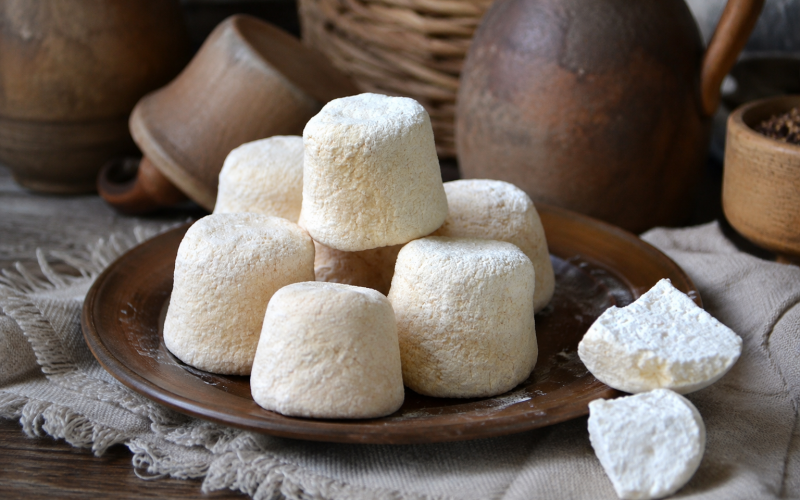
Armenian cuisine is famous for its rich variety of breads, grilled meats, stuffed vegetables, soups, cheeses, herbs, and sweets. Yet some of the most fascinating elements of the country’s culinary heritage are not necessarily the dishes that appear most often on restaurant menus. Among them is chortan, a traditional Armenian dairy product with a remarkably simple appearance and a surprisingly long culinary history.
Chortan is traditionally made from strained fermented dairy products, particularly tan, and formed into small balls that are dried for preservation. Once dried, the balls can be stored for extended periods and later eaten or softened in water and used as an ingredient in other foods. The Armenian word չորթան refers specifically to curds or a dairy product formed into dried balls from tan.
At first glance, chortan may seem like a simple dried food. In reality, it represents an entire way of thinking about food that was essential to traditional Armenian rural life: making use of available ingredients, preserving them naturally, preparing supplies for winter, and turning dairy products into foods that could remain useful long after the fresh product had disappeared.
The story of chortan is therefore not simply the story of one Armenian food. It is a story about preservation, geography, agriculture, family traditions, and the resourcefulness of generations of Armenian cooks.
What Is Chortan?
Chortan is a traditional Armenian dried dairy product. It is generally made by straining fermented dairy, particularly tan, until much of the liquid is removed. The remaining thick dairy mass is shaped into small balls and dried.
The Armenian tourism authorities describe chortan as balls of strained yogurt that are left to dry for future use. Other descriptions connect the product with dried curds and pressed yogurt or milk solids, reflecting the fact that preparation methods can vary between regions and households.
This variation is important. Traditional Armenian food does not always fit neatly into the categories used by modern cookbooks. A food can be an ingredient, a preserved product, and a dish depending on how it is prepared and served.
Chortan is a perfect example.
In its dried form, it is a compact and durable dairy product. When softened with water, it can be transformed into a liquid or creamy ingredient. Historically, it could be incorporated into soups and other hearty dishes, giving them a characteristic sour dairy flavor.
The result is a food designed not merely for immediate consumption, but for storage and future cooking.
The Meaning Behind the Name
The Armenian name for the product is չորթան, commonly transliterated into English as chortan. An alternative Armenian form, չորաթան (choratan), is also recorded. The word has a long history in Armenian, with the form chortan traced to Middle Armenian.
The spelling can vary when the word is written in Latin characters. Travelers and food writers may encounter forms such as chortan, choratan, or other transliterations.
For an English-language audience, Chortan is the clearest and most recognizable spelling when referring specifically to the Armenian product.
The name is also interesting because chortan belongs to a much broader family of dried fermented dairy foods found across parts of Eurasia. Related foods are known under different names in different regions, including qurut, qurt, kurut, and other terms.
This does not make the Armenian product interchangeable with every other dried dairy food. Each regional tradition has its own ingredients, preparation methods, uses, and cultural associations. In Armenia, chortan has its own place within the country’s culinary heritage.
Why Did Armenians Make Chortan?
To understand chortan, it helps to imagine a traditional household without refrigerators, supermarkets, or year-round access to fresh dairy products.
Milk was highly valuable, but fresh milk and yogurt were perishable. Rural households therefore developed numerous ways to transform dairy into products that could be stored for later use.
Fermentation was one method. Straining was another. Drying provided an additional way to remove moisture and make food considerably easier to preserve.
Chortan combines these techniques.
A fermented dairy product is concentrated by removing liquid, shaped into compact portions, and then dried. Once sufficiently dry, it becomes much more practical to store than fresh yogurt or tan.
Historical Armenian food records show chortan being prepared as part of winter provisions. In Harput, for example, traditional households are documented as preparing chortan together with other preserved dairy products for winter. The dried balls could later be soaked and mashed before being incorporated into food.
This is one of the most important things about chortan: its purpose was not simply to create a distinctive flavor. It was a practical preservation technology.
Chortan and the Armenian Landscape
Armenian cuisine has been shaped by the country’s mountains, valleys, high plateaus, changing seasons, and agricultural traditions.
For centuries, many Armenian communities depended heavily on agriculture and livestock. Dairy products naturally played an important role in areas where families kept cattle, sheep, or other animals.
The seasonal nature of rural life meant that food production could fluctuate dramatically. During periods when milk was plentiful, households needed ways to preserve its nutritional and culinary value for periods when fresh dairy was less abundant.
Drying was especially useful.
Unlike fresh yogurt, a properly dried dairy product could be transported and stored. It was compact, durable, and could be rehydrated when necessary.
This logic appears in many traditional foods around the world, but in Armenia it became part of a distinctive culinary culture that also included dried herbs, preserved fruits, grains, cheeses, and other foods prepared for future consumption.
Chortan therefore belongs to a larger Armenian tradition of making the most of seasonal abundance.
The Main Ingredient: Fermented Dairy
The central element of traditional chortan is fermented dairy.
One important starting point is tan, the traditional Armenian fermented yogurt drink. Depending on the preparation, tan can be strained so that much of its liquid is removed, leaving behind a thick dairy mass.
Another closely related Armenian product is matsun, a traditional fermented yogurt. Strained matsun, known as kamats matsun, can also be dried to produce chortan.
The exact preparation can differ according to local and family traditions. Some historical descriptions characterize chortan as pressed and dried yogurt, milk solids, and curds, while other descriptions focus specifically on strained tan.
This diversity is typical of traditional food.
Before standardized industrial recipes existed, a dish or preserved food was often defined by a method rather than by an exact list of ingredients measured to the gram. A household might make its chortan slightly differently from its neighbor while still considering both versions authentic.
How Traditional Chortan Is Made
Although individual recipes vary, the fundamental idea is straightforward.
First, a fermented dairy product is prepared. The product is then strained to remove excess liquid. What remains is a thick, concentrated mass.
This mass is shaped into small portions, traditionally balls. The individual pieces are then dried, traditionally using natural air and sunlight where conditions allow.
As moisture leaves the product, the dairy becomes firm and increasingly shelf-stable.
The size and shape of the balls can vary. Their appearance is usually simple: small, pale pieces of dried dairy that may look more like stones than something intended for the kitchen.
That appearance is deceptive.
Once rehydrated, chortan can become soft again and can be incorporated into cooking.
Traditional preparation requires patience. Drying cannot be rushed if the goal is long-term preservation. The product must lose sufficient moisture while maintaining the qualities needed for later use.
This is one reason why traditional preserved foods tell us so much about the societies that created them. Their preparation reflects an understanding of time, weather, storage, and food chemistry developed long before modern food science provided formal explanations.
From Dried Balls to a Cooked Dish
One of the most interesting aspects of chortan is that the dried product is not necessarily the end of the culinary process.
When needed, the hard pieces can be softened with warm or hot water. Historical Armenian culinary records describe soaking chortan for several hours, then crushing or pressing it into a paste before boiling it with other ingredients.
In this way, chortan functions almost like a preserved culinary concentrate.
It can return to a form that is much closer to its original dairy consistency and then become part of soups, porridges, and other dishes.
Historical recipes from Armenian communities describe chortan being used with cracked wheat and sautéed onions. In one example, the soaked chortan is turned into a paste and boiled together with cooked groats.
Other traditional descriptions show chortan being used in a dish based on parboiled groats, yogurt, garlic, clarified butter, and red pepper.
This is why describing chortan simply as a “dried yogurt ball” does not tell the whole story.
It is also a preserved ingredient capable of becoming part of a complete meal.
What Does Chortan Taste Like?
The flavor of chortan is strongly influenced by its fermented dairy base.
It generally has a pronounced tangy or sour dairy character. Drying concentrates the flavors, making the finished product considerably more intense than fresh yogurt.
Depending on the recipe and how it is later prepared, the flavor can become softer and creamier after rehydration.
When incorporated into a soup or other cooked dish, chortan can provide acidity and depth without requiring large quantities of additional seasoning.
This is particularly interesting in the context of Armenian cuisine, where fresh herbs and naturally flavorful ingredients often play an important role.
Chortan is not designed to be a delicate, neutral dairy ingredient. Its character is distinctive. For someone tasting it for the first time, the concentrated sourness may be the most memorable feature.
But this intensity is exactly what makes it useful in traditional cooking.
Chortan and Traditional Armenian Soups
One of the most important culinary uses of chortan is in soups.
Historical sources document specific chortan soups in Armenian communities. A traditional preparation from the Sassoun region, for example, combines parboiled groats with chortan and other ingredients.
Another documented preparation involves cracked wheat and softened chortan, with sautéed onions used as an important flavor component.
These dishes demonstrate how preserved foods could become the foundation of substantial meals.
The combination of dairy and grains is particularly logical for traditional rural cooking. Grains provided an economical source of energy, while fermented dairy contributed richness, acidity, and additional nutritional value.
The resulting dishes could be hearty without relying on expensive or complicated ingredients.
This is one of the defining characteristics of many traditional foods: what appears simple is often the result of generations of practical culinary knowledge.
Chortan in Armenian Rural Life
Traditional Armenian cuisine cannot be separated from the rhythms of rural life.
Families who produced their own dairy products were not simply cooking for today’s meal. They were also planning for the months ahead.
Milk could become yogurt. Yogurt could be strained. Strained dairy could be transformed into cheese, curds, or chortan. These foods could then be stored and used throughout the year.
Such practices reduced waste and made seasonal resources available beyond their natural season.
Historical descriptions of Armenian households show that dairy preservation was closely connected with winter preparation. Alongside butter, cheese, and other preserved products, chortan could be stored and later rehydrated for cooking.
The result was a pantry built around preservation.
In this context, chortan was not an exotic delicacy. It was part of a practical household system.
Family Recipes and Regional Variations
There is no reason to expect every traditional Armenian family to have prepared chortan in exactly the same way.
Regional Armenian cuisine has always included local variations. Differences in dairy products, climate, available grains, herbs, and household customs naturally affected recipes.
Some families may have preferred a particular consistency. Others could have changed the proportions or the way the dried product was later incorporated into food.
Historical Armenian culinary documentation illustrates this variety. Recipes associated with different communities can feature chortan alongside different grains, seasonings, dairy preparations, and cooking techniques.
This is an important distinction between traditional food and a standardized commercial product.
A traditional recipe is often better understood as a family of related techniques rather than a single fixed formula.
Chortan and the Wider World of Dried Dairy Foods
Chortan is part of a broader culinary tradition found across large parts of Eurasia.
Related dried fermented dairy products are known by names such as qurut or qurt in parts of Central Asia and kurut in Kyrgyzstan. Similar products also exist under other names in neighboring culinary traditions.
These foods share a basic principle: fermented milk or yogurt is concentrated and dried so that it can be preserved.
The exact origins of this broad family of foods are difficult to establish with certainty. Different regions developed their own versions, and food traditions traveled across borders through migration, trade, pastoralism, and cultural exchange.
For Armenia, however, the important point is that chortan has become part of the country’s own culinary vocabulary and traditional food culture.
It should therefore be understood both within the wider history of preserved dairy foods and within the specific context of Armenian cuisine.
Chortan Compared with Fresh Yogurt and Matsun
To understand chortan better, it is useful to compare it with the fresh dairy products from which it can be made.
Matsun is a traditional Armenian fermented yogurt. It is soft, creamy, and perishable.
Tan is a fermented yogurt-based drink, generally more liquid than matsun.
Strained yogurt removes part of the liquid and becomes thicker.
Chortan takes the preservation process even further: the concentrated dairy mass is formed and dried until it becomes firm and shelf-stable.
In other words, these products can be viewed as different stages or applications of a broader dairy tradition.
The transformation from liquid or creamy dairy to a dried product demonstrates the practical ingenuity of traditional Armenian food preparation.
The Role of Chortan in Armenian Cuisine Today
Modern refrigeration has changed the reasons for making many preserved foods.
People no longer need to dry yogurt simply because they have no other way to keep dairy through the winter. Supermarkets provide fresh products throughout the year, and modern kitchens offer equipment that earlier generations could not have imagined.
Yet traditional foods do not necessarily disappear when their original practical purpose becomes less important.
Instead, their cultural meaning can become even more significant.
Chortan survives as a reminder of traditional Armenian foodways. It connects contemporary kitchens with older methods of preserving dairy and preparing seasonal food.
It can also appeal to people interested in traditional ingredients, fermentation, food history, and regional cuisine.
Chortan in the Armenian Diaspora
Armenian culinary traditions have traveled far beyond the borders of the modern Republic of Armenia.
Communities around the world have preserved family recipes and adapted them to local circumstances. Ingredients that were readily available in one historical homeland may be harder to find elsewhere, while modern kitchens can make some traditional techniques easier.
This means that Armenian dishes can develop multiple versions while remaining connected to a common cultural heritage.
Chortan is particularly interesting in this regard because it is not among the most internationally famous Armenian foods. Its survival often depends less on commercial popularity and more on family knowledge.
A grandmother teaching a younger generation how to prepare a traditional dairy product can preserve culinary history just as effectively as a cookbook.
How to Experience Chortan in Armenia
For travelers interested in Armenian food, chortan offers a different kind of culinary experience.
Famous Armenian dishes are relatively easy to find in restaurants and tourist-oriented establishments. Lesser-known foods may require more curiosity.
Visitors can encounter traditional dairy products in local markets, village communities, regional food experiences, and restaurants specializing in traditional Armenian cuisine.
The best way to understand a product like chortan is not necessarily to taste it in isolation.
It is more interesting to learn:
- how it was traditionally made;
- which dairy products were used;
- how families stored it;
- how it was rehydrated;
- which dishes were prepared with it;
- and what role it played in the household.
This turns tasting into a cultural experience.
Instead of simply asking, “What does this taste like?”, travelers can ask, “Why did people make this food, and how did they use it?”
The second question reveals much more about Armenia.
Chortan as an Example of Armenian Food Philosophy
Traditional Armenian cuisine often demonstrates an impressive ability to transform simple ingredients into foods with complex flavors and practical uses.
Chortan is a particularly clear example.
Its fundamental ingredients are humble. Fermented dairy, salt, time, and drying can produce something that can be stored and later transformed into a meal.
There is no need for elaborate equipment or exotic ingredients.
The sophistication lies in the technique.
Fermentation develops flavor. Straining concentrates the dairy. Shaping makes the product easy to portion. Drying extends its useful life. Rehydration brings it back into the kitchen.
Every stage has a purpose.
This is why traditional foods can be valuable historical documents. They reveal what people had available, what problems they needed to solve, and what kinds of flavors they valued.
The Nutritional Side of Chortan
Because chortan is made from concentrated fermented dairy, its nutritional composition is also concentrated compared with the original liquid product.
The exact nutritional profile depends on the ingredients and preparation method, so it is difficult to give one universal nutritional value for all traditional chortan.
However, dairy-based ingredients can provide protein and minerals, while the fermentation and drying processes significantly affect the final product’s composition.
It is also worth remembering that traditional foods were not developed according to modern nutritional charts.
They were developed according to practical needs.
A preserved dairy product that could survive for months and be transformed into a hearty soup was valuable because it helped households make effective use of seasonal resources.
Its nutritional value was part of that usefulness, but not the only reason for its existence.
How Chortan Can Be Used in Modern Cooking
Modern cooks can approach chortan in several ways.
The simplest is to treat it as a traditional preserved dairy product and taste it in its dried form.
Another approach is to rehydrate it and use it as an ingredient.
Once softened, chortan can contribute a characteristic fermented dairy flavor to soups and grain-based dishes.
It can also inspire modern interpretations. Contemporary chefs interested in Armenian ingredients may use traditional products in new presentations while retaining their characteristic flavor.
The important thing is to understand the original product before attempting to reinvent it.
A modern interpretation becomes more meaningful when the cook knows what the traditional ingredient was intended to do.
Why Lesser-Known Armenian Foods Matter
Internationally, Armenian cuisine is often represented by a relatively small number of famous dishes.
Lavash, khorovats, dolma, gata, harissa, and other recognizable foods have helped introduce Armenian culinary traditions to audiences around the world.
But no cuisine can be fully understood through its most famous dishes alone.
Everyday foods, preserved ingredients, regional specialties, and family recipes often tell a different story.
Chortan belongs to this deeper layer of Armenian culinary culture.
It demonstrates how food can preserve knowledge about climate, agriculture, household organization, and seasonal life.
It also reminds us that culinary heritage is not necessarily glamorous.
Sometimes it is a small dried ball of fermented dairy kept in a household pantry for the winter.
And that can be just as historically meaningful as a celebrated feast dish.
Preserving the Tradition of Chortan
Traditional foods survive when people continue to make them, talk about them, teach them, and eat them.
Documentation is important, especially for regional and family variations that may otherwise disappear.
Older generations often possess culinary knowledge that was never written down. Measurements may have been described in terms such as “until it feels right” or “until it is dry enough.” Cooking times could depend on weather, the quality of ingredients, or the experience of the person preparing the food.
Recording these traditions can help preserve them.
Restaurants and chefs also have a role to play by introducing lesser-known ingredients to younger generations and international visitors.
And travelers can contribute simply by being curious.
Trying a traditional food, asking questions, and learning its story can help ensure that it is remembered as more than a forgotten recipe.
Chortan and the Living Heritage of Armenian Cuisine
One of the most fascinating things about Armenian food is the way ancient techniques remain relevant in modern kitchens.
Chortan illustrates this perfectly.
The original reason for making it was largely practical: preserve dairy, reduce waste, create a food that could be stored, and make it available for future meals.
Today, the practical necessity may be less urgent. Refrigeration and modern food distribution have changed everyday life.
But the technique still tells a story.
It tells us about Armenian households that planned for winter. It tells us about communities that relied on local agriculture and livestock. It tells us about the importance of dairy products and fermentation. And it tells us how generations of cooks learned to preserve food without modern technology.
That makes chortan more than an ingredient.
It is a small piece of living culinary history.
Why Chortan Is More Than Just a Dish
Chortan may not be the first Armenian food that comes to mind when people think about the country’s cuisine. It does not have the international recognition of lavash or the visual appeal of a traditional Armenian feast.
Yet its simplicity is precisely what makes it fascinating.
Made from fermented and strained dairy and preserved through drying, chortan represents an ingenious response to the practical challenges of traditional rural life. It allowed Armenian households to preserve the value of dairy products, store them for later, and transform them into nourishing and flavorful dishes when needed.
Its story also demonstrates why Armenian cuisine cannot be reduced to a list of famous recipes.
To understand the country’s food culture, it is necessary to look at the ingredients people preserved, the techniques they developed, the seasonal rhythms that shaped their kitchens, and the recipes that passed from one generation to another.
Chortan is a modest food, but its history is anything but modest.
It connects the Armenian kitchen with mountains and villages, dairy farming and seasonal abundance, winter preparation and family tradition. It also belongs to a wider Eurasian tradition of preserving fermented dairy, while retaining its own distinctive place in Armenian culinary culture.
For anyone traveling through Armenia, discovering foods like chortan can offer a deeper experience than simply trying the country’s most famous dishes. It is an opportunity to taste not only an ingredient, but a piece of the knowledge and resourcefulness that shaped Armenian life for generations.
And that is the real story of chortan: a simple traditional food that preserves much more than dairy — it preserves a way of life.




