

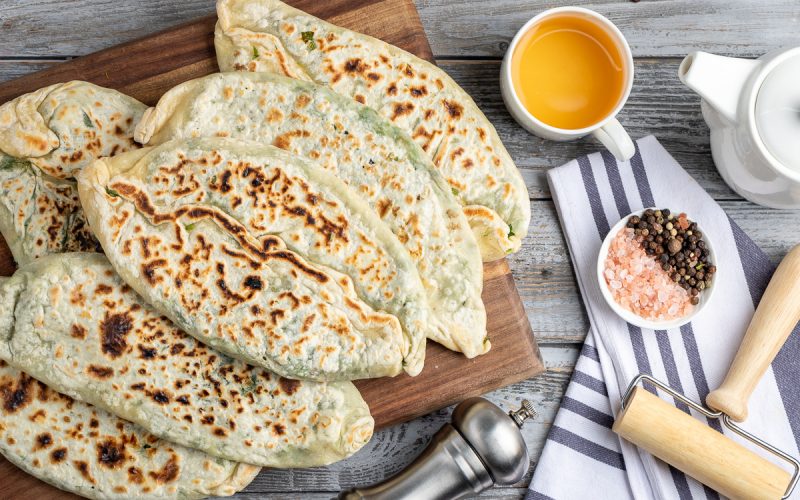
In most cuisines, flatbread is a side dish — something to scoop, wrap, or dip. In the Armenian highlands, there is a flatbread that is the main story. It holds no meat, no cheese, no sauce. Instead, it is filled with the wild taste of mountains, meadows, and spring itself. This is Zhingyalov Hats, one of the most distinctive and poetic dishes in Armenian culinary tradition.
More than just bread with greens, Zhingyalov Hats is a reflection of landscape, season, and memory. To eat it is, in a way, to taste the mountains.
What Is Zhingyalov Hats?
The name Zhingyalov Hats roughly translates to “bread with herbs” or “flatbread with greens.” At first glance, it looks simple: a thin, round flatbread, lightly browned on the outside. But once you tear it open, you see its true character — a dense layer of finely chopped green herbs packed inside.
The dough is unleavened and rolled very thin, almost like a wrap. Inside is a mixture of many types of greens, chopped so finely that they become a soft, fragrant filling. When cooked, the herbs steam inside the bread, creating a juicy, aromatic interior that contrasts with the slightly crisp exterior.
It is typically eaten hot, fresh off the griddle, and almost always with the hands. No sauces are needed. The flavor is complete on its own.
Geographic Roots – Born in the Mountains of Artsakh
Zhingyalov Hats originates from Artsakh (also known as Nagorno-Karabakh), a mountainous region historically inhabited by Armenians. This rugged land of high elevations, rocky slopes, and alpine meadows is rich in wild edible plants — especially in spring.
In such an environment, people traditionally relied not only on farming and herding but also on foraging. Wild herbs, leafy greens, and edible plants were a vital part of the local diet. Over time, these gathered greens found their way into a dish that perfectly expressed the landscape they came from.
Zhingyalov Hats is, in many ways, a product of necessity transformed into culture. What grew naturally in the mountains became the heart of a beloved regional specialty.
The Heart of the Dish – Wild Mountain Herbs
The most remarkable thing about Zhingyalov Hats is not the bread — it’s the filling. Traditionally, the flatbread contains anywhere from 10 to over 20 different types of greens. The exact mix depends on what is available, the season, and family tradition.
These herbs play different roles in the flavor:
- Mild and leafy greens form the base (such as spinach or chard)
- Sour greens like sorrel add brightness
- Aromatic herbs such as dill, cilantro, and wild garlic bring fragrance
- Slightly bitter wild plants add depth and complexity
In its homeland, many of these greens are not cultivated but gathered from fields and hillsides. Each plant contributes something subtle: a note of sharpness, sweetness, or earthiness. Together, they create a layered, living flavor that can’t be replicated with just one or two herbs.
Because the mix changes with the seasons and local ecology, no two batches of Zhingyalov Hats are ever exactly the same. It is a dish that shifts with nature.
Seasonal Cooking – A Springtime Ritual
Zhingyalov Hats is especially associated with spring. After long mountain winters, the first wild greens push through the soil, and families head outdoors to gather them. This seasonal abundance of fresh plants turns into one of the year’s most anticipated foods.
Spring greens are more than ingredients — they are symbols of renewal and life after winter. Preparing Zhingyalov Hats becomes part of a seasonal rhythm, a culinary celebration of nature waking up again.
In the past, foraging trips were social events. Knowledge about which plants were edible, when to pick them, and how to use them was passed down through generations. The dish is tied not only to the land, but to the knowledge of how to live with that land.
How Zhingyalov Hats Is Traditionally Made
Despite its complex flavor, the preparation is built on simplicity.
Dough
The dough contains only flour, water, and salt. There is no yeast and usually no oil. It is kneaded until smooth and then divided into small balls.
Filling
The herbs are washed, dried, and chopped very finely. They are mixed together, sometimes with a little salt and a small amount of oil, but traditionally without cheese or meat. The greens are the star — nothing should overpower them.
Shaping and Cooking
Each piece of dough is rolled into a very thin circle. A generous layer of greens is spread over half, and the dough is folded over like a half-moon and sealed. It is then rolled gently again to distribute the filling evenly.
The flatbread is cooked on a saj — a large, convex metal griddle — or on a dry pan. As it cooks, the dough browns in spots while the greens steam inside, softening and releasing their aroma.
Cooking as Community – The Social Side of Zhingyalov Hats
Zhingyalov Hats is rarely made alone. Because of the many herbs that must be cleaned and chopped, preparation is often a group effort. One person washes greens, another chops, another rolls dough, and another cooks.
In Artsakh, the dish has even been celebrated through Zhingyalov Hats festivals, where large groups gather to cook and share it together. It is a food of hospitality — something to offer guests, neighbors, and friends.
Through the act of making it together, cooking becomes a way of strengthening social bonds and preserving tradition.
Flavor Profile – What Does It Taste Like?
For those unfamiliar with it, the taste of Zhingyalov Hats can be hard to imagine. It is deeply green — fresh, slightly tangy, sometimes gently bitter, and very aromatic. The flavors are layered but delicate, never heavy.
There’s a sense of eating something alive and seasonal, like a meadow captured in bread. The thin dough provides structure but never overshadows the herbs. Each bite is juicy, fragrant, and surprisingly satisfying, even without rich ingredients like meat or cheese.
Zhingyalov Hats in Modern Armenia
Though it began as a regional specialty, Zhingyalov Hats is now known throughout Armenia. In Yerevan and other cities, restaurants serve their own versions. Because many wild herbs are hard to find outside mountainous areas, urban recipes often rely more on cultivated greens like spinach, parsley, and dill.
Even with adaptations, the spirit of the dish remains: abundance of greens, thin dough, and a focus on freshness. For many Armenians, it represents a culinary link to rural roots and mountain heritage.
Cultural Meaning – More Than Just Food
Zhingyalov Hats carries emotional weight. For people connected to Artsakh and the surrounding regions, it can represent home, memory, and identity. It reflects a way of life closely tied to nature — one where people knew the land well enough to feed themselves from its wild plants.
It is also an example of sustainable, plant-based cooking long before such ideas became global trends. The dish shows how traditional food cultures made full use of local biodiversity with respect and care.
Can You Make It Outside Armenia?
Yes — but it will always be a little different. The exact wild herbs may not be available, yet the essence of the dish can still be honored. The key is variety: combine as many different greens and herbs as possible, balancing mild, sour, and aromatic flavors.
What matters most is the philosophy behind it: seasonal ingredients, simplicity, and respect for the plants themselves.
Eating the Mountains
Zhingyalov Hats is proof that simple food can carry deep meaning. With just flour, water, and a handful of greens, it tells a story of mountains, seasons, and generations of people who lived in close connection with the land.
To bite into this flatbread is to taste more than herbs. It is to taste spring after winter, fields after snow, and the quiet richness of a landscape turned into food.
And if you want to taste stories like this for yourself, join us for culinary experiences that bring the flavors of the mountains to life.





26 Responses
Downloaded the x888apk. It is a good one to be honest. Download yours and give x888apk a try.
Used to play on 1001juegos all the time back in the day. Still a great site if you want some simple, free games. Check out 1001juegos for a trip down memory lane.
Just took a look at 25phdream. Seems like a new site offering exciting games and promos. Worth a shot if you are looking for fresh websites. Go check 25phdream out.
BYU Casino Login – Time to see if I can remember my details! Hoping for some luck on the tables or reels. Wish me luck guys! byu casino login
¡Qué onda! Checando Caliente.mx online siempre encuentro buenas opciones para apostar. Es mi sitio favorito, la verdad. Échenle un ojo caliente.mx online
Just finished the MNL63 login and registration process. It was quick and painless, unlike some other sites I’ve tried. Nice! Register and login here: mnl63 login register
[1416]rm88 Official Login | Online Slots Malaysia Fast Deposit,rm88 provides a seamless gaming experience. Get the app download for easy access and learn how to play baccarat with our guides. Join now for fast transactions. visit: rm88
[2472]cbaji Official Login | বিকাশ পেমেন্ট ও সেরা অনলাইন ক্যাসিনো বোনাস,cbaji অ্যাপ ডাউনলোড করে সেরা স্লট গেমের নিয়ম জানুন এবং বিকাশ দিয়ে সহজে গেম খেলুন। আকর্ষণীয় বোনাস পেতে আজই জয়েন করুন। visit: cbaji
[6182]bet1777 Official Login | বিকাশ দিয়ে অনলাইনে ক্যাসিনো গেম খেলুন,bet1777 অ্যাপ ডাউনলোড করে সহজেই স্লট গেম খেলার নিয়ম জানুন। বিকাশ দিয়ে নিরাপদ লেনদেনের মাধ্যমে সেরা ক্যাসিনো অভিজ্ঞতার জন্য আজই জয়েন করুন। visit: bet1777
I’ve tried many platforms but this one is really smooth. The payouts are fast and the games are super exciting. Definitely a great choice for locals! phpjiliph
[2469]bonoclub Login Oficial | Slots en Vivo y Depósitos Cofefi,Accede a bonoclub para disfrutar de las mejores slots en vivo. Descarga la APK oficial y realiza tus depósitos con Cofefi de forma segura. ¡Regístrate ahora! visit: bonoclub
This place has such a fun vibe and the bonuses are actually generous. It is my new favorite way to unwind after work. Cheers to phokfunph for the awesome service.
[6522]JiliAsia7: Official Login, Register & App Download | Best Online Slots & Casino Bonus,Experience the thrill of JiliAsia7, the premier destination for online slots and casino games in the Philippines. Register today to access our official login, download the app, and claim exclusive bonuses for a seamless betting experience. visit: jiliasia7
The login process is so quick and easy. I love how stable the connection is even during peak hours. Just use bet939gamelogin and you will see what I mean.
Secure and professional. I feel safe depositing my funds here and the withdrawals are lightning fast. Go to 77888betlogin.
If you’re looking for a place with great bonuses for new players, this is it. I had a blast winning my first few rounds. Visit 999wingame for the best action.
Just had a massive win here and the withdrawal process was a breeze. Great customer support too. Give jun885bet a go if you are looking for action
Registering was so easy, I was in the game within minutes. The welcome bonuses are a great touch for new players. Get started at 567jiliregister
[7101]betongame লগইন ও অ্যাপ ডাউনলোড | বিকাশ ক্যাসিনো গেম,betongame লগইন করুন এবং বিকাশ দিয়ে ক্যাসিনো গেম উপভোগ করুন। এখানে পাবেন লাইভ ক্যাসিনো বোনাস অফার ও স্লট গেম। আজই অ্যাপ ডাউনলোড করে শুরু করুন। visit: betongame
Bet93911 is where it’s at right now. The features are interesting, and I’m liking the overall vibe. Definitely giving it a thumbs up! Here you go: bet93911
If you are looking for a secure way to get into your account and start winning, this is the place. superace777login makes the whole process seamless.
I’ve tried a few sites lately but this one really stands out. The interface is smooth and the payouts feel fair. Definitely checking out kayarayaslot more often!
It really felt like my lucky day when I joined this site. The graphics are great and the gameplay is very addictive. Five stars from me! luckyday33
The bonus system on xlxwinplataforma is quite generous compared to other sites I’ve used. It really helps when you are just starting out. Definitely worth checking out. xlxwinplataforma
I love how stable the login process is. No more annoying crashes when I’m on a winning streak! bw777login
Love the VIP treatment here. The rewards are actually generous and the support team is very helpful. Five stars for takbatvip.