

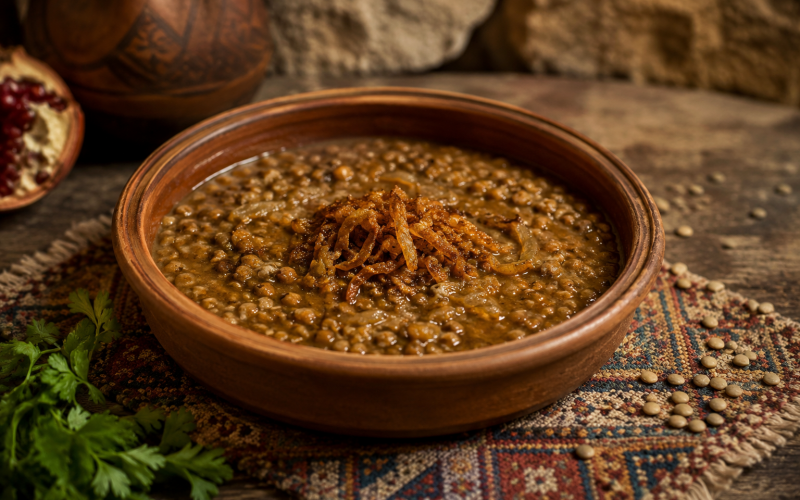
Armenian cuisine is one of the world’s oldest culinary traditions, shaped by thousands of years of history, mountainous landscapes, and a deep respect for locally grown ingredients. While internationally recognized dishes such as dolma, lavash, khorovats, and harissa often represent Armenia abroad, countless traditional recipes remain known primarily within Armenian households. Among these culinary treasures is Mshosh (Մշոշ)—a hearty lentil dish that has nourished generations of Armenians with its remarkable simplicity, nutritional value, and comforting flavor.
Unlike elaborate festive meals prepared for weddings or major celebrations, Mshosh belongs to the category of everyday food. It is the type of dish that generations of Armenian families have cooked for ordinary lunches, weeknight dinners, religious fasting periods, and gatherings around the family table. Made from humble ingredients such as lentils, walnuts, onions, herbs, and vegetable oil, it demonstrates one of the defining characteristics of Armenian cooking: transforming inexpensive, readily available ingredients into food that is deeply satisfying both nutritionally and emotionally.
Today, Mshosh feels surprisingly modern despite its ancient origins. As more people embrace plant-based diets, sustainable cooking, and wholesome ingredients, this traditional Armenian recipe naturally fits contemporary eating habits. It is rich in plant protein, dietary fiber, healthy fats, vitamins, and minerals, while requiring no complicated techniques or expensive products.
Yet Mshosh is far more than a healthy recipe. It tells the story of Armenia itself—its agricultural heritage, its rural communities, its seasonal rhythms, and its enduring culinary traditions. Every spoonful reflects centuries of knowledge passed from one generation to the next, preserving techniques and flavors that have survived despite changing lifestyles and historical upheavals.
Whether served warm as a comforting main course, enjoyed at room temperature as part of a larger Armenian meal, or prepared during Lent as a nourishing meat-free dish, Mshosh continues to symbolize the warmth and generosity of Armenian home cooking.
In this comprehensive guide, we’ll explore the fascinating history of Mshosh, discover why lentils and walnuts became one of Armenia’s most beloved culinary pairings, examine the dish’s cultural significance, learn how it is traditionally prepared, and provide an authentic recipe you can recreate in your own kitchen.
What Is Mshosh?
At its heart, Mshosh is a traditional Armenian dish built around cooked lentils, finely chopped walnuts, caramelized onions, aromatic herbs, and gentle seasonings. While its ingredient list appears modest, the combination creates a surprisingly rich and satisfying flavor profile that has remained popular for centuries.
Unlike soups or stews, Mshosh occupies a unique place within Armenian cuisine. Depending on the family recipe, it may be served as:
- a vegetarian main course;
- a hearty side dish;
- part of a festive table filled with traditional appetizers;
- a Lenten meal;
- or even as a filling for flatbreads and pastries in some regional traditions.
Its texture falls somewhere between a warm lentil salad and a thick grain-based dish. Properly prepared Mshosh is moist but not soupy, allowing each ingredient to remain distinct while blending into a harmonious whole.
The pronunciation of the Armenian word Մշոշ is approximately “Mshosh,” with the “sh” sound pronounced as in the English word she.
Although recipes vary from family to family, the essential identity of Mshosh has remained remarkably consistent. Lentils provide substance, walnuts contribute richness, onions add sweetness, herbs bring freshness, and a careful balance of seasoning ties everything together.
The result is a dish that feels both rustic and refined—simple enough for everyday meals yet flavorful enough to appear on holiday tables.
A Celebration of Simplicity
One of the defining qualities of Armenian cuisine is its ability to elevate ordinary ingredients through thoughtful preparation rather than excessive complexity.
Mshosh perfectly illustrates this philosophy.
There are no elaborate sauces, expensive spices, or complicated cooking techniques involved. Instead, the recipe relies on the natural qualities of its ingredients:
- earthy lentils;
- sweet caramelized onions;
- buttery walnuts;
- fragrant herbs;
- mild spices.
Each ingredient complements the others without overwhelming them.
This balance reflects centuries of culinary experience, where recipes evolved not through extravagance but through careful observation of flavor, texture, and nutrition.
Naturally Vegetarian Long Before It Became Trendy
One of the most remarkable aspects of Mshosh is that it has always been a naturally vegetarian dish.
Long before terms such as plant-based, vegan, or flexitarian entered modern vocabulary, Armenian families were preparing balanced meals centered on legumes, grains, vegetables, herbs, nuts, and dairy.
Historically, this developed for several reasons.
First, meat was not available every day for many rural households. Livestock represented valuable economic resources, and meat was often reserved for celebrations or special occasions.
Second, the Armenian Apostolic Church prescribes numerous fasting periods throughout the year, during which meat and animal products are traditionally avoided. These fasting traditions encouraged the development of sophisticated plant-based recipes capable of providing both nourishment and satisfaction.
Mshosh became one of the finest examples of this culinary creativity.
Today, nutrition experts recognize the combination of legumes and nuts as an excellent source of plant-based protein and healthy fats—a principle Armenian cooks had understood through practical experience for generations.
The Main Characteristics of Mshosh
Although countless family recipes exist, authentic Mshosh usually shares several defining features.
Lentils as the foundation – Lentils form the heart of the dish. Unlike some recipes where legumes simply play a supporting role, in Mshosh they are the primary ingredient. Their earthy flavor creates the foundation upon which the entire dish is built.
Walnuts add richness – Armenia has long been known for its walnut trees, and walnuts appear in many traditional recipes. In Mshosh they provide richness, texture, healthy fats, and subtle sweetness. Their slightly creamy consistency contrasts beautifully with the tender lentils.
Caramelized onions – Slowly cooked onions contribute one of the dish’s most important flavor components. Rather than adding sharpness, properly caramelized onions introduce gentle sweetness that balances the earthiness of the lentils.
Fresh herbs – Fresh herbs brighten the dish and prevent it from becoming too heavy. Depending on regional traditions, cooks may use parsley, cilantro, dill, green onions, or mint. These herbs reflect Armenia’s long tradition of cooking with fresh seasonal greens.
Mild seasoning – Unlike cuisines that rely heavily on hot spices, Armenian cooking generally favors moderation. Black pepper, coriander, cumin, or paprika may appear in certain recipes, but they support rather than dominate the overall flavor.
The Ancient Origins of Mshosh
To truly appreciate Mshosh, it is essential to understand the historical landscape in which it developed.
Armenia occupies a unique geographical position at the crossroads of Europe and Asia. For thousands of years, the Armenian Highlands served as an important center of agriculture, trade, and cultural exchange. Archaeological discoveries indicate that this region was among the earliest places where humans cultivated crops, domesticated animals, and developed settled farming communities.
Within this agricultural world, legumes—particularly lentils—became one of the most dependable food sources available.
Lentils in Ancient Armenia
Lentils have been cultivated across the Near East and the Armenian Highlands since prehistoric times. Their popularity was no accident.
Compared with many other crops, lentils offered numerous practical advantages:
- they adapted well to local growing conditions;
- they matured relatively quickly;
- dried lentils could be stored for long periods;
- they retained much of their nutritional value during storage;
- they provided valuable protein when meat was scarce.
For farming communities facing unpredictable weather and long winters, these qualities made lentils indispensable.
Unlike fresh vegetables, which spoiled quickly, properly dried lentils could feed families throughout the year.
Food for Mountain Communities
Life in historical Armenia was often shaped by geography.
Many villages were located in mountainous regions where winters were cold, transportation difficult, and agricultural seasons relatively short.
Communities learned to rely on ingredients that were durable, nutritious, easy to preserve, and locally available.
Lentils perfectly matched these requirements.
Combined with onions harvested in late summer, walnuts collected in autumn, and herbs either freshly picked or dried for winter use, they formed the basis of numerous nourishing meals.
Mshosh emerged naturally from these conditions—not as a luxurious invention but as a practical solution for feeding families with the resources available.
The Wisdom Behind the Recipe
Modern nutrition science often celebrates combinations of legumes and nuts because together they provide an excellent balance of protein, fiber, healthy fats, and essential minerals.
Remarkably, Armenian cooks developed this combination centuries before such nutritional concepts were formally understood.
The pairing was driven by experience.
Families noticed that meals combining lentils with walnuts were more filling, more satisfying, easier to sustain physical labor, suitable for fasting periods, and economical without sacrificing nutrition.
Over time, these practical observations evolved into tradition.
Rather than following written recipes, each generation learned by watching parents and grandparents cook. Small adjustments were made according to local ingredients and family preferences, but the heart of the dish remained unchanged.
In this way, Mshosh became far more than a simple lentil recipe—it became an expression of Armenian resilience, resourcefulness, and respect for wholesome food.
The Cultural Importance of Mshosh
Food has always been much more than nourishment in Armenian culture. It serves as a bridge between generations, a symbol of hospitality, and a reflection of the country’s agricultural heritage. Among the many dishes that have been passed down through centuries, Mshosh occupies a special place because of its remarkable versatility. It is humble enough to appear on an ordinary weekday table, yet meaningful enough to be served during important religious periods and family gatherings.
Unlike ceremonial dishes prepared only for major holidays, Mshosh became woven into everyday Armenian life. It was the kind of meal that families could prepare using ingredients already stored in their pantry, making it dependable during every season of the year.
A Dish for Everyday Life
Historically, Armenian households were built around practicality.
Most families relied on agriculture, animal husbandry, orchards, and vegetable gardens. Every ingredient had value, and meals were planned carefully to make the best use of available resources.
Mshosh perfectly fit this lifestyle because its ingredients were inexpensive, easy to preserve, and highly nutritious.
A typical household often had dried lentils harvested the previous season, onions stored in cool cellars, walnuts gathered during autumn, dried or fresh herbs, and vegetable oil pressed locally.
Because these products remained available throughout much of the year, Mshosh became a dependable everyday meal. Unlike dishes requiring fresh meat or seasonal vegetables, it could be prepared almost any time.
Nourishment for Working Families
For centuries, much of Armenia’s population lived in rural communities where physical labor dominated everyday life.
Farmers worked long hours cultivating fields, caring for livestock, harvesting fruit, gathering firewood, and maintaining their homes.
Meals needed to satisfy several important requirements. They had to be filling, nutritious, affordable, easy to prepare, and capable of feeding large families.
Mshosh fulfilled every one of these needs.
A generous serving provided slow-releasing carbohydrates from lentils, healthy fats from walnuts, vitamins from herbs, and enough energy to sustain people throughout demanding workdays.
Unlike meals centered on expensive ingredients, Mshosh demonstrated that wholesome nutrition could come from modest resources.
Passed Down from Generation to Generation
Many traditional Armenian recipes survived without ever being written down.
Instead, culinary knowledge was transferred through observation.
Children learned by watching their parents and grandparents prepare meals.
A grandmother might explain how soft the lentils should become, exactly when onions were perfectly caramelized, how finely walnuts should be chopped, and how many herbs to add according to the season.
Measurements were often approximate. Instead of cups or grams, recipes relied on experience. Instructions such as “cook until the onions smell sweet” or “add enough herbs to brighten the dish” reflected a cooking tradition built on intuition rather than strict formulas.
As a result, no two families prepared Mshosh in exactly the same way. Each household preserved its own version while remaining faithful to the dish’s essential identity.
Mshosh During Lent and Religious Fasting
One of the reasons Mshosh has remained so popular throughout Armenian history is its close connection with the traditions of the Armenian Apostolic Church.
Throughout the liturgical year, Armenian Christians observe several fasting periods, during which meat and, depending on the observance, other animal products are avoided.
These fasting traditions encouraged the development of an exceptionally rich repertoire of plant-based dishes.
Rather than viewing fasting as culinary restriction, Armenian cooks transformed it into an opportunity for creativity.
Mshosh became one of the finest examples of this approach.
Its combination of lentils and walnuts provided satisfying nourishment without relying on meat, making it especially suitable during Great Lent before Easter, Advent fasting, weekly fasting days observed by many believers, and other religious periods of abstinence.
Because the dish was already naturally vegetarian—and often vegan—it required little or no adaptation for fasting traditions. This practical advantage helped secure its place in Armenian culinary culture.
Symbolizing Simplicity and Humility
Religious fasting in Armenia has traditionally emphasized modesty, gratitude, and appreciation for simple food.
Mshosh embodies these values perfectly.
Its ingredients are neither luxurious nor extravagant. Instead, the dish celebrates honest agricultural products, careful preparation, patience, moderation, and respect for nature’s abundance.
In many ways, Mshosh reminds us that culinary excellence does not always depend on expensive ingredients. Sometimes the greatest satisfaction comes from preparing ordinary foods with exceptional care.
Hospitality at the Armenian Table
Hospitality occupies a central place in Armenian culture.
Guests are traditionally welcomed generously, and tables are often filled with a remarkable variety of dishes regardless of the occasion.
Although Mshosh is primarily considered home cooking, it frequently appears as part of larger traditional meals.
It pairs beautifully with fresh lavash, seasonal vegetables, Armenian cheeses, pickled vegetables, fresh herbs, and yogurt outside fasting periods.
Its mild flavor complements richer meat dishes while also standing confidently on its own. Because it can be served warm, at room temperature, or even slightly chilled, Mshosh adapts naturally to family feasts where numerous dishes are shared simultaneously.
A Dish That Brings Generations Together
Perhaps the greatest cultural significance of Mshosh lies in its ability to connect generations.
Many Armenians associate the dish with memories of grandparents preparing meals in village kitchens, family lunches after church, quiet weekday dinners, conversations around the dining table, and recipes that never needed written instructions.
For members of the Armenian diaspora, preparing Mshosh often becomes an act of cultural preservation. Even thousands of miles from Armenia, the familiar aroma of caramelized onions, toasted walnuts, and fresh herbs can instantly evoke memories of home.
Traditional Ingredients of Mshosh
The remarkable character of Mshosh comes not from a long ingredient list but from the careful balance between a handful of simple components. Each ingredient contributes its own flavor, texture, and nutritional qualities while supporting the others. Together, they create a dish whose whole is far greater than the sum of its parts.
Lentils: The Heart of Mshosh
No ingredient defines Mshosh more than lentils. They provide the structure, flavor, and nutritional foundation upon which everything else is built.
Lentils have been cultivated across the Armenian Highlands for thousands of years because they are exceptionally well suited to the region’s climate. Their popularity stems from several practical advantages. They are inexpensive to grow, drought tolerant, easy to dry, capable of long-term storage, and naturally rich in nutrients.
For farming communities, these characteristics made lentils indispensable. Unlike fresh vegetables that spoiled quickly, dried lentils could remain edible for months, ensuring reliable food supplies throughout winter.
Which lentils are traditionally used? Different Armenian families use different varieties. Brown lentils are among the most common because they retain their shape while developing a pleasantly tender texture. Green lentils are also popular, particularly when a firmer consistency is preferred. Some modern cooks experiment with French green lentils or black lentils, although these are generally considered contemporary adaptations rather than traditional choices. Red lentils are less common for classic Mshosh because they break down rapidly during cooking and produce a smoother texture. The traditional goal is for each lentil to remain intact while becoming soft and creamy inside.
The flavor of lentils – Properly cooked lentils have an earthy, nutty flavor that forms a perfect foundation for the other ingredients. Their mild taste allows sweet onions, rich walnuts, aromatic herbs, and delicate spices to shine without competition. This harmony is one reason the recipe has endured for centuries.
Walnuts: Armenia’s Signature Ingredient
If lentils provide the heart of Mshosh, walnuts provide its soul. Few ingredients are more closely associated with Armenian cuisine than walnuts. Walnut trees have grown throughout Armenia for centuries, particularly in mountainous and forested regions. Their nuts became an essential ingredient in both sweet and savory cooking. Today, walnuts remain one of the defining characteristics of traditional Armenian food.
Why walnuts matter – Walnuts contribute much more than flavor. They add natural richness, healthy fats, gentle sweetness, satisfying texture, and additional plant protein. Their slightly creamy consistency contrasts beautifully with the soft lentils, making every bite more interesting.
Texture is just as important as flavor – Traditional recipes usually call for walnuts to be chopped rather than finely ground. This creates pleasant variation throughout the dish. Every spoonful contains tender lentils, crisp walnut pieces, soft onions, and delicate herbs. The result is a satisfying texture that keeps Mshosh from feeling monotonous despite its simple ingredient list.
Onions: Building Sweetness Through Patience
Onions play a surprisingly important role in Mshosh. Although often considered a supporting ingredient, they contribute much of the dish’s depth. Rather than being added raw, onions are slowly cooked until they become golden and naturally sweet. During caramelization, their sharp flavor gradually transforms into rich sweetness. This process requires patience but rewards the cook with remarkable complexity. Well-prepared onions balance the earthiness of the lentils while enhancing the buttery notes of the walnuts.
Fresh Herbs: Brightness and Balance
Fresh herbs prevent Mshosh from becoming overly heavy. They introduce freshness, color, and aroma. Depending on family traditions and seasonal availability, Armenian cooks commonly use parsley (adds freshness and mild peppery notes), cilantro (bright herbal aroma), dill (gentle sweetness and delicate fragrance), green onions (freshness without overwhelming), and mint (occasionally added in small quantities to provide subtle contrast). Rather than dominating the recipe, herbs lift the overall flavor and create balance.
Vegetable Oil
Traditional Mshosh is typically prepared with vegetable oil, particularly during fasting periods. Historically, locally available oils varied by region, but the guiding principle remained the same: the oil should enhance the ingredients without masking their natural flavors. A good-quality oil helps coat the lentils, distribute the seasonings evenly, and create a silky, satisfying texture.
Mild Spices
Armenian cuisine generally favors restraint when seasoning food. Instead of bold heat, spices are used to support the natural qualities of the ingredients. Common additions include freshly ground black pepper, coriander, cumin in some regional recipes, and sweet paprika as a modern variation. Salt is added carefully to preserve balance. The objective is harmony rather than intensity.
Optional ingredients – Because Mshosh has been prepared for generations across different regions and households, many families include additional ingredients that reflect local tastes. Some examples include finely minced garlic, a sprinkle of sumac for gentle acidity, fresh pomegranate seeds as a seasonal garnish, lemon juice for brightness, or raisins and dried fruits in a few regional interpretations. Most food historians consider these additions to be variations rather than essential components of the classic recipe. The traditional core remains unchanged: lentils, walnuts, onions, herbs, oil, and gentle seasoning.
Why Lentils and Walnuts Are the Perfect Combination
The enduring popularity of Mshosh is no coincidence. At the heart of the dish lies one of the most successful ingredient pairings in Armenian cuisine: lentils and walnuts.
Long before nutrition science explained why certain foods complement one another, Armenian cooks understood through experience that these two ingredients created a meal that was both deeply satisfying and highly nourishing.
Lentils contribute complex carbohydrates, dietary fiber, and plant-based protein, providing steady energy and a hearty texture. Walnuts, in contrast, add richness through their healthy fats, subtle sweetness, and delicate crunch. Together, they create a balance that neither ingredient could achieve alone.
From a culinary perspective, their flavors naturally enhance each other. The earthy notes of lentils are softened by the buttery quality of walnuts, while caramelized onions and fresh herbs tie everything together into a harmonious whole.
From a nutritional perspective, the combination offers a wide range of valuable nutrients, including protein, fiber, omega-3 fatty acids, magnesium, iron, folate, and antioxidants. This made Mshosh an exceptionally practical meal for generations of Armenians, particularly during periods when meat was scarce or avoided for religious reasons.
Perhaps most importantly, the pairing reflects the wisdom of traditional Armenian cooking: using local, seasonal ingredients to create meals that are wholesome, economical, and deeply satisfying.
How Mshosh Is Traditionally Prepared
One of the reasons Mshosh has remained a favorite in Armenian kitchens for centuries is that it requires no elaborate equipment or advanced culinary skills. Instead, its success depends on careful preparation, quality ingredients, and patience. Like many traditional Armenian recipes, the dish follows a simple philosophy: allow each ingredient to contribute its natural flavor, then bring them together in perfect balance.
Although every family has its own preferred method, the overall preparation process has changed very little over generations.
Step 1: Selecting and Preparing the Lentils
Everything begins with the lentils. Traditional Armenian cooks carefully sort dried lentils by hand, removing any small stones or damaged legumes before rinsing them thoroughly in several changes of cold water. This simple but important step reflects an older style of home cooking, when ingredients often came directly from farms rather than supermarkets. Proper preparation ensures that the finished dish has a clean flavor and an even texture.
Step 2: Cooking the Lentils
Unlike soups, where lentils may cook until they almost dissolve, Mshosh requires a different approach. The goal is to cook the lentils until they are tender, creamy inside, still holding their shape, and neither mushy nor undercooked. Achieving this balance requires attention. If overcooked, the lentils lose their texture and the dish becomes too soft. If undercooked, they remain firm and prevent the ingredients from blending harmoniously. Traditionally, lentils are simmered gently rather than boiled aggressively. Slow cooking helps preserve both texture and flavor. Once ready, they are drained carefully to remove excess liquid while retaining enough moisture to keep the finished dish soft.
Step 3: Slowly Caramelizing the Onions
Many Armenian cooks believe that properly cooked onions determine whether Mshosh will be merely good or truly exceptional. The onions are sliced or finely chopped and cooked slowly over moderate heat. Patience is essential. Rather than browning quickly, the onions gradually soften and release their natural sugars. As they caramelize, their flavor transforms from sharp and pungent to rich, sweet, and almost buttery. This sweetness balances the earthy lentils without requiring additional sugar or heavy seasoning. The aroma filling the kitchen during this stage is often one of the strongest memories associated with homemade Mshosh.
Step 4: Preparing the Walnuts
Walnuts are generally chopped by hand rather than processed into a fine powder. Traditional cooks often prefer irregular pieces because they provide more interesting texture. Some families lightly toast the walnuts before adding them to the dish. This optional step deepens their flavor, enhancing their natural oils and giving Mshosh additional warmth and complexity. Others prefer using raw walnuts, believing their fresher taste better complements the lentils. Both approaches remain faithful to Armenian culinary tradition.
Step 5: Combining the Ingredients
Once the lentils, onions, and walnuts are ready, they are gently mixed together. This stage requires care. The goal is not to mash the ingredients into a paste but to distribute them evenly while preserving the integrity of the lentils. Each spoonful should contain a balanced mixture of tender lentils, sweet onions, crunchy walnuts, and fragrant herbs. This contrast of textures is one of Mshosh’s defining characteristics.
Step 6: Adding Fresh Herbs
Fresh herbs are usually added toward the end of preparation. Adding them too early causes their bright flavors to fade. Depending on the season and regional traditions, cooks may choose different combinations of herbs. Some prefer generous amounts of parsley and cilantro. Others emphasize dill or green onions. Regardless of the selection, herbs bring freshness that balances the richness of the walnuts and the sweetness of the onions. They also give the dish its characteristic vibrant appearance.
Step 7: Balancing the Seasoning
Traditional Armenian cooking values restraint. Rather than overwhelming ingredients with strong spices, cooks taste the dish carefully and adjust seasoning gradually. Usually this involves salt, freshly ground black pepper, and occasionally coriander or cumin. The objective is balance. Every ingredient should remain recognizable. No single flavor should dominate.
Step 8: Allowing the Dish to Rest
Although many people are tempted to serve Mshosh immediately, experienced Armenian cooks often recommend letting it rest for a short time. During this period flavors become more harmonious, walnuts absorb some moisture, herbs blend naturally with the lentils, and seasoning distributes more evenly. Many families believe the dish tastes even better after resting for thirty minutes or longer. Some even prefer preparing Mshosh several hours before serving.
Regional Variations Across Armenia
One of the most fascinating aspects of Armenian cuisine is its regional diversity. Although Armenia is geographically small, its varied landscapes, climates, and historical influences have produced numerous local cooking traditions. As with many beloved family recipes, there is no single “official” version of Mshosh. Instead, each region—and often each household—prepares it slightly differently.
Eastern Armenian Traditions
In Eastern Armenia, Mshosh is typically prepared as a hearty everyday meal. Recipes often emphasize generously cooked lentils, sweet caramelized onions, chopped walnuts, and abundant fresh herbs. The overall flavor remains balanced and mild, allowing the natural qualities of each ingredient to stand out. Many families serve it warm alongside fresh lavash and seasonal vegetables.
Western Armenian Variations
Western Armenian culinary traditions developed under different historical and geographical influences, resulting in subtle variations. Some family recipes may include additional spices, garlic, lemon juice, or slightly different herb combinations. These additions create brighter flavors while preserving the dish’s essential identity. Because many Western Armenians settled throughout the Middle East and other regions during the twentieth century, local ingredients sometimes influenced family recipes, producing further variations.
Mountain Village Recipes
Villages located in Armenia’s mountainous regions often preserved older culinary traditions. Here, Mshosh tends to be especially rustic. Ingredients are prepared with minimal processing. Walnuts may be chopped more coarsely. Herbs are often gathered fresh from nearby fields and gardens. The emphasis remains firmly on wholesome nourishment rather than elegant presentation. In these communities, recipes were shaped primarily by seasonal availability. Families cooked with what nature provided rather than following fixed formulas.
Urban Armenian kitchens – As Armenia became increasingly urbanized during the twentieth century, Mshosh naturally adapted to changing lifestyles. City cooks often introduced small practical modifications, such as using pre-cleaned lentils, preparing the dish more quickly, incorporating additional vegetables, or adjusting herbs according to market availability. Despite these conveniences, the core recipe remained largely unchanged. Even in modern apartments, Mshosh continues to evoke memories of village kitchens and family traditions.
Family traditions matter more than geography – Although regional differences certainly exist, most Armenians would agree that the greatest variations occur between families rather than provinces. Every household develops its own interpretation. One grandmother may insist that parsley is essential. Another might never prepare Mshosh without dill. Some families chop walnuts very finely. Others leave large pieces for additional texture. Certain cooks serve it warm. Others prefer it after it has cooled slightly. None of these differences are considered incorrect. Instead, they demonstrate the living nature of Armenian culinary heritage. Recipes evolve gently while preserving their essential character.
Mshosh in Armenian Home Cooking
Few dishes illustrate Armenian domestic cooking as clearly as Mshosh. Unlike restaurant specialties or elaborate holiday recipes, it belongs to the rhythm of everyday family life. For generations, Armenian households have relied on Mshosh because it combines practicality with genuine comfort.
A reliable weekday meal – Busy farming families historically needed meals that could be prepared without rare or expensive ingredients. Mshosh met these requirements perfectly. Most households already had everything needed: lentils, onions, walnuts, herbs, and oil. Preparation required attention but not constant supervision, allowing cooks to continue other household work while lentils simmered.
Perfect for large families – Another reason for Mshosh’s enduring popularity is its ability to feed many people economically. A relatively small quantity of lentils expands considerably during cooking. Combined with onions and walnuts, the finished dish becomes generous enough to satisfy an entire family. This made it especially valuable during periods when resources needed to be used carefully.
Suitable for every season – Although many people associate lentil dishes with colder months, Mshosh is surprisingly versatile. During winter it is served warm with fresh lavash for a comforting meal. In spring it is accompanied by abundant fresh herbs and seasonal vegetables. In summer it appears at room temperature as part of a larger spread of traditional Armenian dishes. In autumn it is prepared using freshly harvested walnuts and herbs. Few traditional recipes adapt so naturally throughout the changing seasons.
An ideal dish for shared meals – Armenian dining is built around sharing. Instead of individual portions, families often place several dishes in the center of the table. Everyone serves themselves while enjoying conversation together. Mshosh fits beautifully into this tradition. It pairs naturally with fresh tomatoes, cucumbers, Armenian cheeses, olives, pickled vegetables, grilled vegetables, and warm lavash. Its mild flavor complements stronger dishes without competing with them.
A favorite for meal preparation – Long before the modern concept of “meal prep” became popular, Armenian families appreciated another advantage of Mshosh. The dish stores exceptionally well. Many people believe its flavor actually improves after several hours, once the ingredients have had time to meld together. For this reason, Mshosh is often prepared in generous quantities. Leftovers can be enjoyed the following day for lunch or dinner with little or no loss of quality. This practicality further explains why the recipe has survived for centuries.
A symbol of Armenian home cooking – Ultimately, Mshosh represents something larger than a lentil dish. It reflects a way of cooking based on seasonal ingredients, respect for tradition, economical use of food, patience, and family knowledge passed through generations. Every household may prepare it slightly differently, yet every version expresses the same philosophy: good food does not require extravagance—only wholesome ingredients, careful preparation, and the desire to nourish the people gathered around the table.
The Nutritional Benefits of Mshosh
One of the reasons traditional dishes survive for centuries is that they are not only culturally meaningful but also practically valuable. They provide nourishment that matches the needs of the communities that created them.
Mshosh is an excellent example of this principle. Although it was developed long before modern nutrition science existed, the combination of lentils, walnuts, onions, herbs, and vegetable oil creates a remarkably balanced meal. The ingredients reflect an intuitive understanding of nutrition: combining different plant-based foods to create something satisfying, energy-rich, and nourishing.
Today, as more people explore healthy eating patterns, Mediterranean-style diets, and plant-based cuisine, Mshosh feels surprisingly contemporary.
A Rich Source of Plant-Based Protein
Lentils are among the most valuable plant sources of protein. For centuries, they played an essential role in Armenian households because they provided an affordable alternative to meat. Protein is necessary for maintaining muscle tissue, supporting daily energy needs, repairing cells, and keeping the body strong and resilient. In traditional Armenian villages, where physical labor was part of everyday life, protein-rich foods were especially important. A meal like Mshosh could provide long-lasting energy without requiring expensive ingredients. The addition of walnuts further improves the nutritional profile by contributing additional plant protein and healthy fats. Together, lentils and walnuts create a satisfying combination that helps the dish feel complete rather than simply a side dish.
High in Dietary Fiber
Another important nutritional quality of Mshosh is its high fiber content. Lentils naturally contain significant amounts of dietary fiber, which supports healthy digestion, stable energy levels, feelings of fullness after meals, and balanced nutrition. Traditional Armenian cooks may not have used the modern term “dietary fiber,” but they understood the practical benefits of legumes. Meals based on lentils were known to be filling and sustaining, making them ideal for hardworking families.
Healthy Fats from Walnuts
Walnuts are one of the ingredients that make Mshosh especially distinctive. Unlike many dishes based only on grains or legumes, Mshosh receives additional richness from nuts. Walnuts contain unsaturated fats, omega-3 fatty acids, antioxidants, and important minerals. These healthy fats contribute not only to nutrition but also to the sensory experience of the dish. They create a smoother texture and add a subtle buttery flavor that balances the earthy character of lentils. This combination demonstrates an important principle of traditional cooking: nutritious ingredients can also make food more enjoyable.
Vitamins and Minerals
Mshosh contains a wide variety of naturally occurring vitamins and minerals. The exact nutritional content depends on the recipe, but typical ingredients contribute valuable nutrients. Lentils provide iron, folate, magnesium, potassium, and zinc. Walnuts provide magnesium, copper, manganese, and antioxidants. Fresh herbs provide vitamin K, vitamin C, and plant compounds with antioxidant properties. Onions contribute sulfur-containing compounds, antioxidants, and natural plant nutrients. Together, these ingredients create a dish that is nutritionally dense despite its simplicity.
A naturally sustainable dish – Beyond personal health, Mshosh also reflects principles that are increasingly important today: sustainability and responsible food choices. Traditional Armenian cooking developed around efficient use of available resources. Plant-based dishes such as Mshosh required fewer resources than meat-based meals, ingredients that could be stored for long periods, minimal food waste, and locally grown products. The dish demonstrates how traditional communities naturally developed sustainable cooking practices long before environmental concerns became part of modern conversations.
Mshosh and Armenian Culinary Philosophy
To understand why Mshosh has endured for generations, it is not enough to look only at ingredients. The dish represents a broader philosophy of Armenian cuisine—a way of thinking about food that values simplicity, seasonality, and respect.
Respect for Simple Ingredients
Armenian cuisine has never depended on complicated techniques or excessive decoration. Instead, it focuses on understanding ingredients. A skilled cook knows how to reveal the best qualities of grains, legumes, vegetables, herbs, and nuts. Mshosh demonstrates this perfectly. There are no elaborate sauces or complex cooking processes. The dish succeeds because each ingredient has a clear purpose.
Seasonal Cooking and Local Products
For centuries, Armenian families cooked according to what was available at different times of the year. The rhythm of life followed the agricultural calendar. Spring brought fresh greens. Summer provided vegetables and herbs. Autumn brought nuts and preserved foods. Winter required stored ingredients. Mshosh reflects this seasonal approach. Its ingredients were practical because they could be stored and used throughout the year. Dried lentils and walnuts were particularly valuable because they remained available even during colder months when fresh produce was limited.
The Armenian tradition of preserving food – Food preservation has always been an important part of Armenian household culture. Families traditionally prepared ingredients that could last through winter, such as dried fruits, pickled vegetables, preserved herbs, dried legumes, and stored nuts. Mshosh fits naturally into this tradition. It uses ingredients that represent careful planning and respect for future needs. A family preparing Mshosh was not simply making dinner—they were continuing a practical knowledge system developed over generations.
Plant-based cooking before modern trends – Today, plant-based cuisine is often associated with modern lifestyle choices. However, Armenian culinary traditions demonstrate that plant-focused eating has existed for centuries. Mshosh is a reminder that vegetarian cooking is not a new invention. Across Armenian history, families developed countless dishes based on beans, lentils, grains, vegetables, nuts, and herbs. These foods were not considered substitutes for something else. They were complete and respected dishes in their own right.
Hospitality through humble food – One of the most beautiful aspects of Armenian cuisine is that hospitality does not depend on expensive ingredients. A generous host does not need rare products to create a meaningful meal. A simple dish prepared with care can communicate warmth and generosity. Mshosh represents this idea perfectly. A bowl of lentils, walnuts, and herbs may appear modest, but when shared with family or guests, it becomes a symbol of attention and respect.
Mshosh Compared with Other Armenian Dishes
Armenian cuisine includes many traditional dishes with deep historical roots. Comparing Mshosh with other famous recipes helps reveal what makes it unique.
Mshosh vs. Eetch
Eetch is another traditional Armenian vegetarian dish that often appears on Armenian tables. Although both dishes are plant-based, they are fundamentally different. Eetch is primarily a bulgur-based dish. Its main ingredients usually include fine bulgur, tomatoes or tomato paste, onions, herbs, peppers, and lemon juice. It has a brighter, fresher character and is often compared to dishes from the broader Eastern Mediterranean region. Mshosh is centered around lentils, walnuts, caramelized onions, and herbs. Its flavor is deeper, warmer, and more earthy. While Eetch highlights grains and fresh acidity, Mshosh celebrates legumes and nuts.
Mshosh vs. Harissa
Harissa is one of Armenia’s most famous traditional foods. Although both dishes represent Armenian heritage, they serve very different purposes. Harissa is made from wheat, meat, and long cooking. The ingredients are slowly cooked until they create a thick, almost porridge-like consistency. It is strongly associated with Armenian history, community gatherings, and national identity. Mshosh is lighter, vegetarian, more everyday-oriented, and based on legumes rather than grains. Both dishes share a common philosophy: patience, simplicity, nourishment, and connection to tradition. However, harissa is often associated with collective celebrations, while Mshosh is closely connected to the family kitchen.
Mshosh vs. Lentil Soups
At first glance, Mshosh may appear similar to lentil soups found throughout the Middle East and Mediterranean. However, the preparation and serving style make it distinct. Many lentil soups are liquid-based, heavily spiced, and served as starters. Mshosh is usually thicker, more textured, served as a complete meal or side dish, and centered around the contrast between lentils and walnuts. Its identity comes from the relationship between ingredients rather than from broth or spices.
Mshosh vs. Fasulya and other bean dishes – Armenian cuisine includes many traditional dishes based on beans and legumes. Fasulya, for example, is typically prepared as a bean-based stew. Like Mshosh, it demonstrates Armenia’s long relationship with plant proteins. However, the flavor profiles differ. Bean stews often emphasize tomato-based sauces, richer gravies, and longer cooking. Mshosh is more focused on the natural taste of lentils, walnut richness, and fresh herbs.
Modern Interpretations of Mshosh
Although Mshosh is an ancient dish, it continues to evolve. Modern cooks are rediscovering traditional Armenian recipes and introducing them to new audiences. The goal is not to replace the original version but to demonstrate how adaptable this dish can be.
Vegan Mshosh
The classic recipe is already naturally vegan in many versions. However, modern cooks may highlight this quality by adapting the dish for contemporary plant-based diets. Possible additions include extra vegetables, roasted peppers, seasonal greens, or additional herbs. The essential combination of lentils and walnuts remains unchanged.
Gourmet Restaurant Versions
Some chefs introduce Mshosh into modern Armenian cuisine through creative presentation. Possible approaches include elegant plating, decorative herb arrangements, refined textures, or pairing with contemporary dishes. These interpretations help introduce traditional Armenian flavors to international audiences.
Creative ingredient variations – While respecting tradition, some modern cooks experiment with additions such as roasted vegetables, pomegranate seeds, lemon zest, different varieties of nuts, or fresh seasonal greens. These adaptations demonstrate the flexibility of Armenian cuisine. A traditional recipe does not have to remain frozen in time to remain authentic.
Mshosh in the modern healthy food movement – Today, many people are searching for food that is nutritious, affordable, environmentally responsible, and rich in natural ingredients. Mshosh naturally meets these expectations. It offers plant-based protein, healthy fats, simple preparation, and ancient culinary wisdom. This makes it relevant not only as a historical recipe but also as a modern everyday meal.
A dish connecting past and present – Perhaps the greatest strength of Mshosh is its ability to exist between two worlds. It belongs to the past because it carries centuries of Armenian culinary tradition. At the same time, it belongs to the present because its qualities perfectly match modern interest in healthy, sustainable, plant-based food. Few dishes demonstrate so clearly that traditional cuisine is not outdated. Sometimes the oldest recipes are the ones most suited for the future.
How to Serve Mshosh
One of the beautiful qualities of Mshosh is its versatility. Although the dish has a simple ingredient list, it can appear in many different settings—from a quiet family lunch to a festive Armenian table filled with traditional foods. The way Mshosh is served often depends on the season, occasion, and family preference. Unlike dishes that must be eaten immediately after cooking, Mshosh develops even more character after resting, making it suitable for different serving styles.
Warm, Room Temperature, or Chilled?
Traditionally, Mshosh is most commonly served warm or at room temperature. When served warm, the aroma of walnuts becomes more pronounced, the onions provide comforting sweetness, and the herbs release their fragrance. A freshly prepared bowl of Mshosh is especially satisfying during colder months. However, many families also enjoy it after it has cooled slightly. At room temperature, the flavors often become even more balanced because the lentils absorb the aromas of the onions, herbs, and seasonings. Some modern cooks even serve it slightly chilled, especially during warmer seasons, similar to other Mediterranean-style grain and legume dishes.
Traditional Accompaniments
Mshosh is rarely served completely alone in Armenian cuisine. It is often part of a larger meal where different flavors and textures complement each other.
Lavash – The most traditional companion for Mshosh is Armenian lavash. This thin flatbread has been an essential part of Armenian food culture for centuries. Lavash provides a soft texture contrast, a way to enjoy every part of the dish, and additional warmth and comfort. In many Armenian households, bread is treated with great respect. It is not simply an accompaniment but an important part of the meal itself.
Fresh vegetables – Fresh seasonal vegetables create a refreshing contrast with the rich flavors of lentils and walnuts. Common additions include tomatoes, cucumbers, peppers, and green onions. This combination reflects the Armenian tradition of balancing hearty dishes with fresh produce.
Fresh herbs – Additional herbs may be placed on the table so that each person can adjust the flavor according to personal preference. Popular choices include parsley, cilantro, dill, mint, and green onions. Fresh greens are deeply connected with Armenian cuisine and often accompany almost every traditional meal.
Pickled vegetables – Pickled foods provide acidity that balances the richness of walnuts. Traditional Armenian tables often include pickled peppers, cucumbers, cabbage, or mixed vegetables. Their sharp, bright flavors create contrast with the earthy sweetness of Mshosh.
Armenian cheese and dairy products – Outside fasting periods, Mshosh may be served alongside dairy products such as Armenian cheeses, yogurt, or fermented dairy dishes. The creamy qualities of dairy create an interesting contrast with the texture of lentils and walnuts.
Authentic Mshosh Recipe
The following recipe represents a traditional-style version of Mshosh. Since Armenian families often prepare the dish differently, this recipe should be viewed as a foundation rather than a strict formula. The most important elements remain: quality lentils, flavorful walnuts, slowly cooked onions, fresh herbs, and balanced seasoning.
Ingredients
Main ingredients:
- 2 cups brown or green lentils
- 1 cup walnuts, roughly chopped
- 2–3 large onions, finely sliced
- 4–5 tablespoons vegetable oil
- ½ cup fresh parsley, chopped
- ¼ cup fresh cilantro, chopped
- 2 tablespoons fresh dill, chopped (optional)
- 2–3 cloves garlic, finely minced (optional)
- salt to taste
- freshly ground black pepper to taste
Optional additions:
Depending on family tradition, you may add:
- 1 teaspoon ground coriander;
- ½ teaspoon cumin;
- a pinch of sweet paprika;
- lemon juice;
- pomegranate seeds for garnish;
- green onions.
Preparation Time
Preparation: 20 minutes
Cooking: 40–60 minutes
Resting time: 30 minutes (recommended)
Servings: 6–8 portions
Step-by-Step Instructions
Step 1: Prepare the Lentils
Rinse the lentils thoroughly under cold running water. Check them carefully and remove any impurities. Place the lentils in a large pot and cover with water. Bring to a boil, then reduce the heat. Cook gently until the lentils become tender but still maintain their shape. This usually takes approximately 25–35 minutes depending on the variety. Avoid overcooking. The goal is a soft but textured consistency, not a puree. Once cooked, drain any excess liquid and set the lentils aside.
Step 2: Prepare the Walnuts
While the lentils are cooking, prepare the walnuts. Chop them into small pieces. Do not grind them completely into powder. The traditional appeal of Mshosh comes partly from the contrast between soft lentils, sweet onions, and crunchy walnut pieces. For deeper flavor, walnuts may be lightly toasted in a dry pan for several minutes. Be careful not to burn them, as walnuts can quickly become bitter.
Step 3: Caramelize the Onions
Heat vegetable oil in a large pan. Add the sliced onions. Cook over medium-low heat, stirring regularly. This stage requires patience. The onions should slowly become soft, golden, and naturally sweet. Do not rush this step by increasing the heat. Fast browning creates a different flavor and may leave the onions sharp rather than sweet. Proper caramelization is one of the secrets of excellent Mshosh.
Step 4: Combine Lentils and Onions
Add the cooked lentils to the pan with the caramelized onions. Mix gently. Allow the ingredients to cook together for several minutes so the lentils absorb the onion flavor. At this stage, add salt, black pepper, and optional spices. Taste and adjust seasoning.
Step 5: Add Walnuts and Herbs
Remove the mixture from heat. Add chopped walnuts and fresh herbs. Stir carefully to distribute everything evenly. Adding herbs at the end preserves their freshness and aroma.
Step 6: Let the Dish Rest
Allow Mshosh to rest before serving. This step is optional but highly recommended. During resting, flavors become deeper, textures become more harmonious, and walnuts absorb some of the surrounding flavors. Many Armenian cooks believe the dish reaches its best taste after it has had time to settle.
Cooking Tips for Perfect Mshosh
Choose good quality walnuts – Because walnuts are one of the defining ingredients, their quality matters. Fresh walnuts should taste slightly sweet, buttery, and pleasantly nutty. Old or poorly stored walnuts may develop bitterness.
Do not overcook the lentils – The texture of Mshosh depends on the lentils remaining recognizable. They should be tender but not broken down completely.
Take your time with onions – The onions create much of the dish’s depth. Slow cooking produces a richer result. This is one area where patience makes a significant difference.
Use fresh herbs whenever possible – Fresh herbs provide brightness and prevent the dish from feeling too heavy. Dried herbs can work in emergencies, but fresh greens create a more authentic flavor.
Allow flavors to develop – Mshosh is one of those dishes that often improves with time. Preparing it slightly in advance can actually enhance the final result.
Common Mistakes When Making Mshosh
Mistake 1: Making the dish too dry – Although Mshosh is not a soup, it should not be completely dry. The lentils should remain moist and coated with the flavors of the onions and oil.
Mistake 2: Using too many spices – Strong seasoning can hide the natural flavors of the main ingredients. Traditional Armenian cooking usually emphasizes balance.
Mistake 3: Grinding the walnuts too finely – A paste-like texture removes one of the dish’s most enjoyable characteristics—the contrast between soft lentils and crunchy nuts.
Mistake 4: Serving immediately without resting – Although Mshosh can be eaten right away, resting allows the flavors to become more unified.
Storage and Meal Preparation
Mshosh is particularly convenient because it stores well.
Refrigerator storage – Place cooled Mshosh in an airtight container. It can usually be kept refrigerated for several days. The flavor often becomes even better the next day.
Freezing – Mshosh can generally be frozen. For best results, cool completely before freezing, store in sealed containers, and thaw gradually. The texture may change slightly after freezing, but the flavor remains enjoyable.
Reheating – Warm gently over low heat. If the dish seems dry after refrigeration, add a small amount of water or oil while reheating.
Why Mshosh Deserves International Recognition
In recent years, the world has become increasingly interested in traditional foods that combine history, nutrition, and sustainability. Mshosh represents all of these qualities. It is ancient yet modern, simple yet flavorful, humble yet culturally significant, and nutritious yet affordable.
A Perfect Example of Culinary Heritage
Every culture has dishes that tell its story. For Armenia, Mshosh represents agricultural traditions, family knowledge, religious customs, respect for ingredients, and the importance of sharing food. It demonstrates how communities can preserve identity through cooking.
A Dish for the Future
Although Mshosh comes from centuries-old traditions, it fits perfectly into modern lifestyles. Today’s cooks are increasingly searching for meals that are plant-based, environmentally conscious, nutrient-rich, budget-friendly, and connected to authentic cultures. Mshosh offers all of these qualities naturally. It does not need to be reinvented—it simply needs to be rediscovered.
A Taste of Armenia’s Culinary Wisdom
Mshosh may not yet be as internationally famous as some other Armenian dishes, but it deserves recognition as one of the country’s most meaningful culinary traditions. Behind its simple ingredients lies a remarkable story of resilience, creativity, and cultural preservation. Lentils represent nourishment. Walnuts represent richness and connection to the land. Herbs represent freshness and seasonal living. Together, they create a dish that has comforted Armenian families for generations.
Mshosh reminds us that great food is not always about complexity or luxury. Sometimes the most memorable dishes are those created from humble ingredients, prepared with patience, and shared with the people we love.
Discovering Mshosh means discovering more than an Armenian recipe. It means discovering a piece of history—a dish that carries the flavors, traditions, and memories of generations who understood that food is one of the strongest ways to preserve culture. Mshosh is not simply a lentil dish. It is a taste of Armenia’s past, present, and future.
A bowl of Mshosh is more than a traditional Armenian recipe—it is a connection to the land, the people, and the generations who shaped Armenia’s culinary identity. Plan your journey to Armenia and experience this remarkable dish where history, hospitality, and flavor come together.




